Skip to main content
General Chemistry
나의 코스
배우기
시험 준비
AI 튜터
학습 가이드
교과서적 해결책
플래시카드
탐험해 보세요
앱을 사용해 보세요
나의 코스
배우기
시험 준비
AI 튜터
학습 가이드
교과서적 해결책
플래시카드
탐험해 보세요
앱을 사용해 보세요
뒤로
Beta Decay definitions
카드를 뒤집기 위해 탭할 수 있습니다.
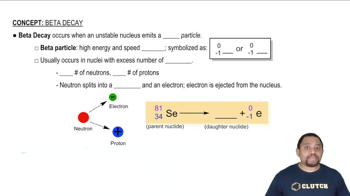
Beta Decay
카드를 뒤집기 위해 탭할 수 있습니다.
👆
Beta Decay
A nuclear process where an unstable nucleus emits a high-speed electron to convert a neutron into a proton.
진행 상황 추적
컨트롤 버튼이 '내비게이션' 모드로 변경되었습니다.
1/14
관련 플래시카드
관련 실천
추천 영상
Beta Decay quiz #1
Beta Decay
10 용어
Beta Decay quiz
Beta Decay
15 용어
Beta Decay
21. Nuclear Chemistry
3 문제점
주제
Jules
Gamma Emission
21. Nuclear Chemistry
3 문제점
주제
Jules
21. Nuclear Chemistry - Part 1 of 3
5 주제
11 문제점
장
Jules
21. Nuclear Chemistry - Part 2 of 3
5 주제
10 문제점
장
Jules
21. Nuclear Chemistry - Part 3 of 3
5 주제
13 문제점
장
Jules
VideoThumbView.guidedCourse
01:21
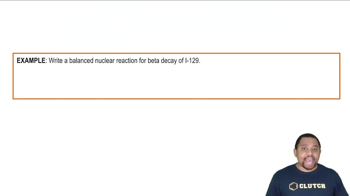
Beta Decay Reaction Example
2070
views
11
rank
VideoThumbView.guidedCourse
03:01
Beta Decay
2368
views
14
rank
VideoThumbView.guidedCourse
01:02
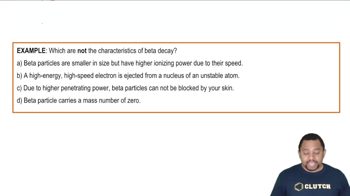
Characteristics of Beta Particles Example
1751
views
14
rank
이 집합의 용어 (14)
하이드의 정의
Beta Decay
A nuclear process where an unstable nucleus emits a high-speed electron to convert a neutron into a proton.
Beta Particle
A high-energy, high-speed electron emitted during beta decay, with negligible mass and negative charge.
Neutron
A subatomic particle in the nucleus with no charge, which can convert into a proton and electron during beta decay.
Proton
A positively charged subatomic particle in the nucleus, increased in number during beta decay.
Electron
A negatively charged subatomic particle ejected from the nucleus during beta decay.
Selenium-81
An isotope that undergoes beta decay to transform into bromine-81, maintaining a mass number of 81.
Bromine-81
The product of selenium-81 after beta decay, with an increased atomic number but unchanged mass number.
Mass Number
The total number of protons and neutrons in a nucleus, unchanged during beta decay.
Atomic Number
The number of protons in a nucleus, increased by one during beta decay.
Ionizing Power
The ability of a particle to ionize atoms, lower for beta particles compared to alpha particles.
Penetrating Power
The ability of a particle to pass through materials, higher for beta particles than alpha particles.
Alpha Particle
A larger particle compared to beta particles, with higher ionizing but lower penetrating power.
Helium-4
An isotope representing alpha particles, consisting of two protons and two neutrons.
Shielding
The use of dense materials like metal or wood to block beta particles due to their penetrating power.
 뒤로뒤로
뒤로뒤로
 01:21
01:21