Skip to main content
General Chemistry
나의 코스
배우기
시험 준비
AI 튜터
학습 가이드
교과서적 해결책
플래시카드
탐험해 보세요
앱을 사용해 보세요
나의 코스
배우기
시험 준비
AI 튜터
학습 가이드
교과서적 해결책
플래시카드
탐험해 보세요
앱을 사용해 보세요
뒤로
Chromatography quiz
카드를 뒤집기 위해 탭할 수 있습니다.
What is the main purpose of chromatography?
카드를 뒤집기 위해 탭할 수 있습니다.
👆
What is the main purpose of chromatography?
Chromatography is used to separate components within a mixture based on their molecular attractions.
진행 상황 추적
컨트롤 버튼이 '내비게이션' 모드로 변경되었습니다.
1/15
관련 플래시카드
관련 실천
추천 영상
Chromatography definitions
Chromatography
15 용어
Chromatography quiz
Chromatography
10 용어
Chromatography quiz #1
Chromatography
10 용어
Chromatography
4. BONUS: Lab Techniques and Procedures
10 문제점
주제
Filtration and Evaporation
4. BONUS: Lab Techniques and Procedures
10 문제점
주제
4. BONUS: Lab Techniques and Procedures
7 주제
15 문제점
장
VideoThumbView.guidedCourse
04:50
Chromatography
5408
views
12
rank
이 집합의 용어 (15)
하이드의 정의
What is the main purpose of chromatography?
Chromatography is used to separate components within a mixture based on their molecular attractions.
What are the two phases involved in chromatography?
The two phases are the stationary phase (usually a silica plate) and the mobile phase (a solvent).
What is the stationary phase in chromatography?
The stationary phase is the part that does not move, typically a silica plate that holds the mixture.
What is the mobile phase in chromatography?
The mobile phase is the moving solvent that travels up the plate by capillary action.
How is a mixture applied in chromatography?
A sample of the mixture is spotted onto the stationary phase, such as a TLC plate.
What determines how far a component travels in chromatography?
The distance a component travels depends on its affinity for the solvent versus the plate.
What happens if a component has a greater attraction to the plate than the solvent?
It will not move very far up the plate, resulting in low movement.
What happens if a component has a greater affinity for the solvent than the plate?
It will move further up the plate with the solvent, showing higher movement.
What is capillary action in the context of chromatography?
Capillary action is the process by which the solvent moves up the plate, carrying the mixture's components.
How are the positions of components marked on a TLC plate?
Positions are marked as starting line, where each component stops, and where the solvent front stops.
What is the Retention Factor (Rf value) in chromatography?
The Rf value is the ratio of the distance traveled by the compound to the distance traveled by the solvent.
How do you calculate the Rf value for a compound?
Divide the distance traveled by the compound by the distance traveled by the solvent.
What does an Rf value of 0.50 indicate about a compound's affinity?
It indicates the compound has a lower affinity for the solvent compared to a compound with a higher Rf value.
How can Rf values help identify compounds in a mixture?
Rf values are compared to known values in a manual to identify the compounds present.
What is the typical composition of a solvent used in chromatography as described in the lesson?
A solvent can be a mixture, such as 50% ethanol (slightly polar) and 50% hexanes (non-polar).
 뒤로뒤로
뒤로뒤로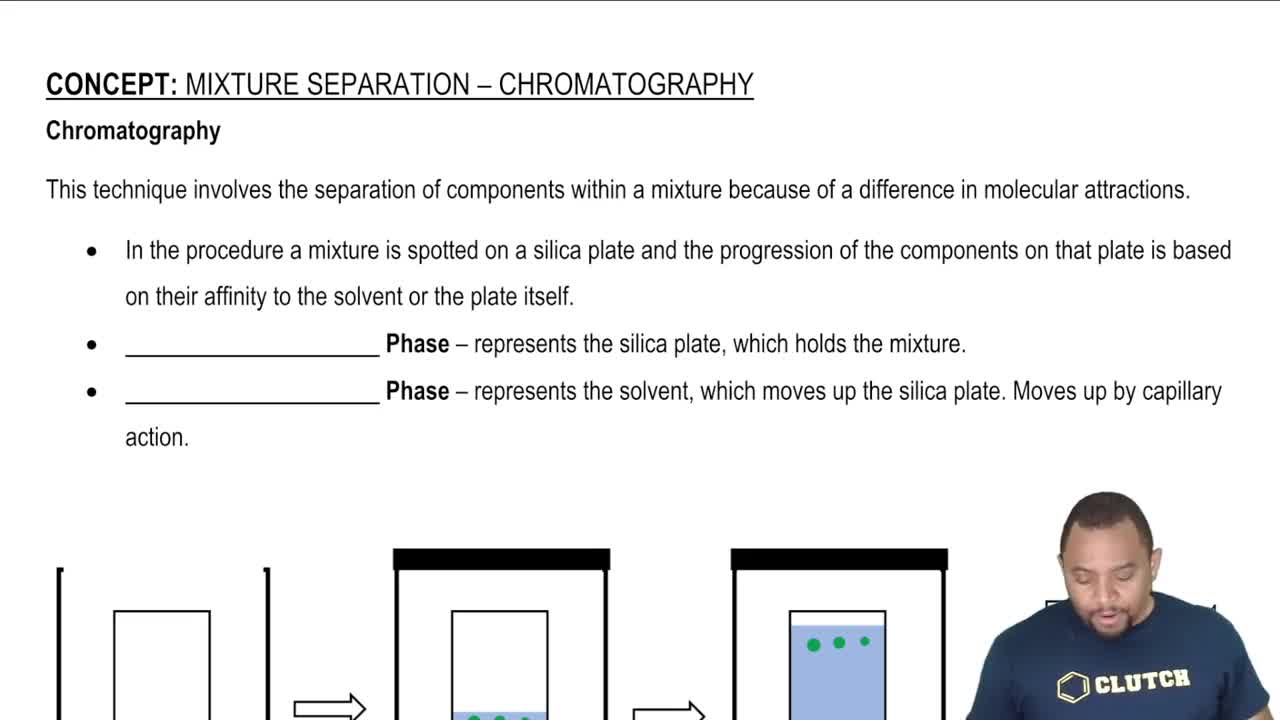
 04:50
04:50