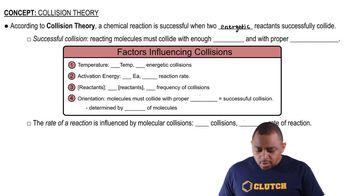
What two conditions must be met for a collision to result in a successful chemical reaction according to collision theory?
Reactant molecules must collide with enough energy and with proper orientation.
How does increasing temperature affect the rate of a chemical reaction?
Increasing temperature raises the energy of collisions, leading to more energetic and frequent successful collisions.
What is activation energy in the context of collision theory?
Activation energy is the minimum energy required for reactant molecules to successfully collide and react.
How does a lower activation energy influence the reaction rate?
A lower activation energy increases the rate of reaction by making it easier for collisions to be successful.
What effect does increasing the concentration of reactants have on collision frequency?
Increasing reactant concentration raises the frequency of molecular collisions, increasing the chance of successful reactions.
Why is molecular orientation important in collision theory?
Proper orientation ensures that molecules collide in the correct spots, which is necessary for a successful reaction.
How does molecular shape affect the orientation factor in collisions?
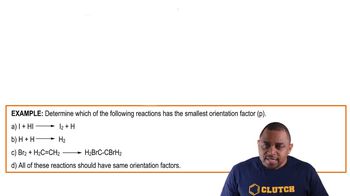
Molecular shape determines how easily molecules can align for a successful collision; larger molecules often have a lower orientation factor.
What does the rate constant (k) represent in the Arrhenius equation?
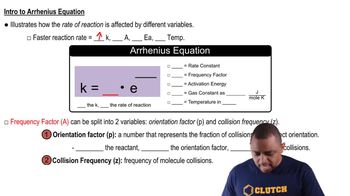
The rate constant (k) quantifies the speed of a chemical reaction; a higher k means a faster reaction.
Write the Arrhenius equation and identify each variable.
The Arrhenius equation is k = A · e^(-Ea/RT), where k is the rate constant, A is the frequency factor, Ea is activation energy, R is the gas constant, and T is temperature in Kelvin.
What is the frequency factor (A) in the Arrhenius equation composed of?
The frequency factor (A) is composed of the orientation factor (P) and the collision frequency (Z).
What does the orientation factor (P) represent?
The orientation factor (P) represents the fraction of collisions that occur with the correct orientation for a reaction.
How does the collision frequency (Z) affect the likelihood of a reaction?
A higher collision frequency (Z) increases the number of molecular collisions, raising the probability of successful reactions.
What happens to the reaction rate if the orientation factor is low?
A low orientation factor means fewer collisions have the correct orientation, resulting in a lower reaction rate.
How does a higher value of the rate constant (k) relate to the speed of a reaction?
A higher rate constant (k) indicates a faster reaction rate.
What is the value and unit of the gas constant (R) used in the Arrhenius equation?
The gas constant (R) is 8.314 joules per mole per Kelvin (J/(mol·K)).
 뒤로
뒤로
 02:22
02:22