Skip to main content
General Chemistry
나의 코스
배우기
시험 준비
AI 튜터
학습 가이드
교과서적 해결책
플래시카드
탐험해 보세요
앱을 사용해 보세요
나의 코스
배우기
시험 준비
AI 튜터
학습 가이드
교과서적 해결책
플래시카드
탐험해 보세요
앱을 사용해 보세요
뒤로
Effusion quiz
카드를 뒤집기 위해 탭할 수 있습니다.
What is meant by the mean free path in the context of gases?
카드를 뒤집기 위해 탭할 수 있습니다.
👆
What is meant by the mean free path in the context of gases?
Mean free path is the average distance a gas molecule travels between collisions with other molecules.
진행 상황 추적
컨트롤 버튼이 '내비게이션' 모드로 변경되었습니다.
1/15
관련 플래시카드
관련 실천
추천 영상
Effusion definitions
Effusion
10 용어
Effusion quiz
Effusion
10 용어
Effusion quiz #1
Effusion
17 용어
Effusion
7. Gases
5 문제점
주제
Jules
Root Mean Square Speed
7. Gases
4 문제점
주제
Jules
7. Gases - Part 1 of 4
5 주제
14 문제점
장
Jules
7. Gases - Part 2 of 4
5 주제
13 문제점
장
Jules
7. Gases - Part 3 of 4
5 주제
13 문제점
장
Jules
7. Gases - Part 4 of 4
5 주제
13 문제점
장
Jules
VideoThumbView.guidedCourse
02:05
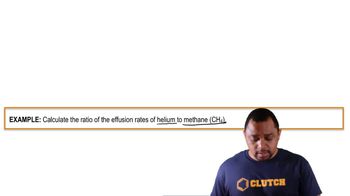
Ratio of Effusion Rate Example
3513
views
18
rank
VideoThumbView.guidedCourse
01:31
Effusion Rate Example
3906
views
20
rank
VideoThumbView.guidedCourse
00:37
Effusion Rate
3628
views
17
rank
이 집합의 용어 (15)
하이드의 정의
What is meant by the mean free path in the context of gases?
Mean free path is the average distance a gas molecule travels between collisions with other molecules.
How do gas molecules behave inside a container?
Gas molecules are in constant motion, spread far apart, and frequently collide with each other.
What is effusion in gases?
Effusion is the escape of gas molecules through a tiny pinhole, typically one molecule at a time.
How does diffusion differ from effusion?
Diffusion is the movement of gas from high to low concentration, while effusion is the escape through a small opening.
What determines the direction of diffusion?
Diffusion always occurs from an area of higher concentration to an area of lower concentration.
How does the size of the opening affect effusion and diffusion?
Effusion occurs through a very small opening, allowing one molecule at a time, while diffusion uses a larger opening, allowing multiple molecules.
What is Graham's law of effusion?
Graham's law states that the rate of effusion is inversely proportional to the square root of the gas's molar mass.
How does molar mass affect the rate of effusion?
Increasing the molar mass of a gas decreases its rate of effusion, meaning heavier gases effuse more slowly.
What is the mathematical relationship for the rate of effusion?
The rate of effusion is proportional to 1 divided by the square root of the molar mass.
How are effusion rates compared between two gases using Graham's law?
The ratio of their effusion rates equals the square root of the inverse ratio of their molar masses.
What is the relationship between effusion rate and time for a gas?
Effusion rate and time are directly proportional for a given gas.
How do you set up a proportion for effusion rates and molar masses between two gases?
Place the rate of one gas over the rate of another, and the molar mass of the second gas over the molar mass of the first.
Why do lighter gases effuse more rapidly than heavier gases?
Lighter gases have lower molar mass, so their effusion rate is higher according to Graham's law.
What is the key difference in movement for effusion versus diffusion?
Effusion is always out of the container through a pinhole, while diffusion can be in or out depending on concentration.
Why is understanding effusion important in chemistry?
Effusion helps predict how quickly gases escape from containers and is essential for comparing behaviors of different gases.
 뒤로
뒤로
 02:05
02:05