Skip to main content
General Chemistry
나의 코스
배우기
시험 준비
AI 튜터
학습 가이드
교과서적 해결책
플래시카드
탐험해 보세요
앱을 사용해 보세요
나의 코스
배우기
시험 준비
AI 튜터
학습 가이드
교과서적 해결책
플래시카드
탐험해 보세요
앱을 사용해 보세요
뒤로
Equilibrium Constant K quiz
카드를 뒤집기 위해 탭할 수 있습니다.
What does the equilibrium constant (K) indicate about a chemical reaction?
카드를 뒤집기 위해 탭할 수 있습니다.
👆
What does the equilibrium constant (K) indicate about a chemical reaction?
K indicates whether the forward or reverse reaction is favored at equilibrium.
진행 상황 추적
컨트롤 버튼이 '내비게이션' 모드로 변경되었습니다.
1/15
관련 플래시카드
관련 실천
추천 영상
Equilibrium Constant K definitions
Equilibrium Constant K
15 용어
Equilibrium Constant K quiz #1
Equilibrium Constant K
10 용어
Equilibrium Constant (K)
16. Chemical Equilibrium
6 문제점
주제
Jules
Equilibrium Constant Calculations
16. Chemical Equilibrium
7 문제점
주제
Jules
16. Chemical Equilibrium - Part 1 of 2
5 주제
13 문제점
장
Jules
16. Chemical Equilibrium - Part 2 of 2
5 주제
13 문제점
장
Jules
VideoThumbView.guidedCourse
01:14
Equilibrium Constant K
6392
views
111
rank
VideoThumbView.guidedCourse
03:20
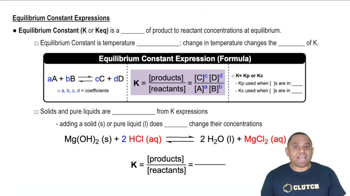
Equilibrium Constant Expressions
5581
views
121
rank
VideoThumbView.guidedCourse
01:07
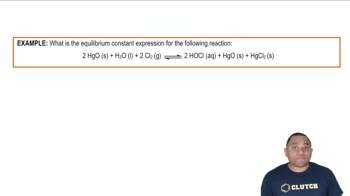
Equilibrium Constant Expressions Example
4817
views
109
rank
1
comments
이 집합의 용어 (15)
하이드의 정의
What does the equilibrium constant (K) indicate about a chemical reaction?
K indicates whether the forward or reverse reaction is favored at equilibrium.
How is the equilibrium constant (K) calculated from a balanced chemical equation?
K is the ratio of the concentrations of products to reactants, each raised to the power of their coefficients.
What does a K value greater than 1 signify about a reaction at equilibrium?
A K greater than 1 means the forward reaction is favored, producing more products.
What does a K value less than 1 indicate about the favored direction of a reaction?
A K less than 1 means the reverse reaction is favored, resulting in more reactants.
What does it mean if the equilibrium constant K equals 1?
If K equals 1, neither the forward nor reverse reaction is favored, and product and reactant concentrations are equal.
Which physical states are excluded from the equilibrium constant expression and why?
Solids and pure liquids are excluded because their concentrations do not change with pressure.
How does temperature affect the equilibrium constant K?
K is temperature-dependent, so changing the temperature changes the value of K.
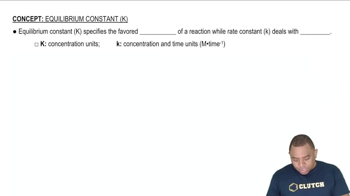
What is the relationship between the equilibrium constant (K) and the rate constants (k) of a reaction?
K equals the rate constant of the forward reaction divided by the rate constant of the reverse reaction.
What is the main difference between the equilibrium constant (K) and the rate constant (k)?
K indicates reaction direction at equilibrium, while k measures the speed of the reaction.
In the equilibrium expression, how are coefficients from the balanced equation used?
Coefficients become exponents for the concentrations in the equilibrium expression.
What are Kc and Kp, and when is each used?
Kc is used for concentrations in molarity, and Kp is used for concentrations in atmospheres.
Why are solids and pure liquids not included in equilibrium expressions?
Their concentrations remain constant and are unaffected by changes in pressure.
If a reaction at equilibrium has more products than reactants, what can you say about K?
K will be greater than 1, indicating the forward reaction is favored.
If a reaction at equilibrium has more reactants than products, what does this say about K?
K will be less than 1, meaning the reverse reaction is favored.
What units are associated with the rate constant (k) that are not part of the equilibrium constant (K)?
The rate constant (k) includes time units, such as seconds inverse, while K does not.
 뒤로뒤로
뒤로뒤로
 01:14
01:14