Skip to main content
General Chemistry
나의 코스
배우기
시험 준비
AI 튜터
학습 가이드
교과서적 해결책
플래시카드
탐험해 보세요
앱을 사용해 보세요
나의 코스
배우기
시험 준비
AI 튜터
학습 가이드
교과서적 해결책
플래시카드
탐험해 보세요
앱을 사용해 보세요
뒤로
Factors Influencing Rates quiz
카드를 뒤집기 위해 탭할 수 있습니다.
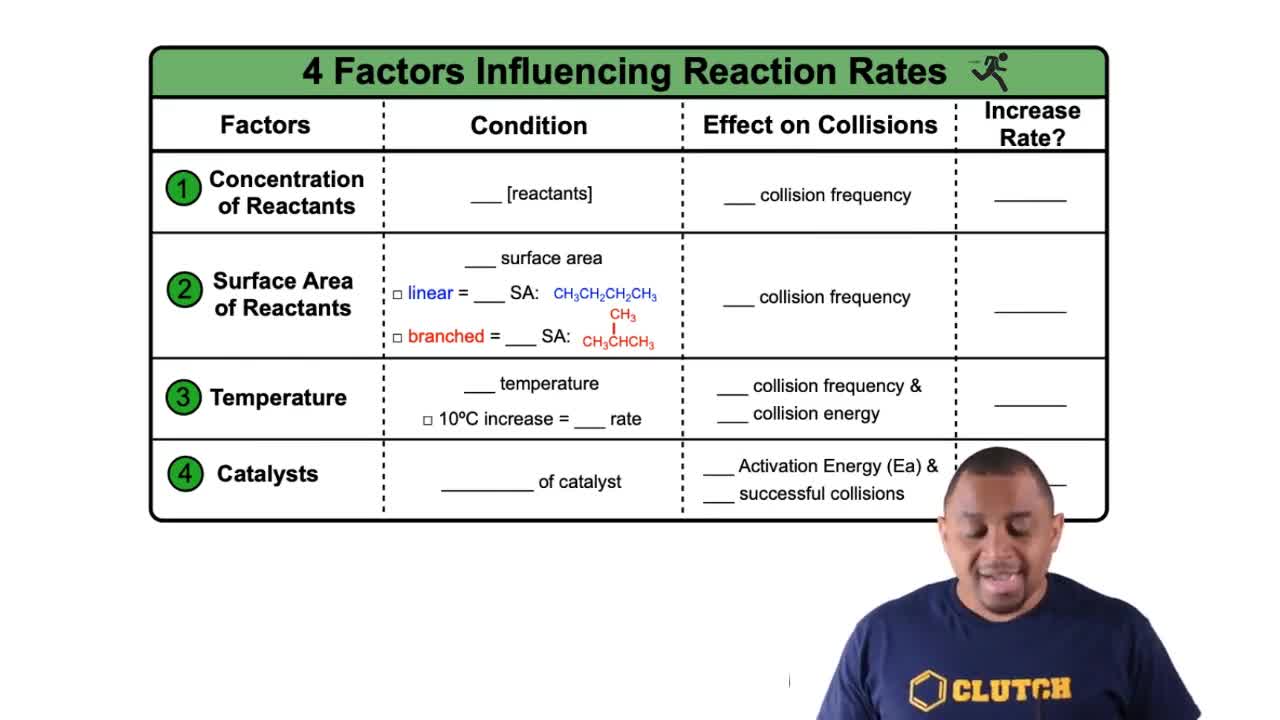
What are the four major factors that influence the rate of a chemical reaction?
카드를 뒤집기 위해 탭할 수 있습니다.
👆
What are the four major factors that influence the rate of a chemical reaction?
The four major factors are reactant concentration, reactant surface area, temperature, and catalysts.
진행 상황 추적
컨트롤 버튼이 '내비게이션' 모드로 변경되었습니다.
1/15
관련 플래시카드
관련 실천
추천 영상
Factors Influencing Rates definitions
Factors Influencing Rates
12 용어
Factors Influencing Rates quiz
Factors Influencing Rates
18 용어
Factors Influencing Rates quiz #1
Factors Influencing Rates
37 용어
Factors Influencing Rates
15. Chemical Kinetics
3 문제점
주제
Jules
Average Rate of Reaction
15. Chemical Kinetics
6 문제점
주제
Jules
15. Chemical Kinetics - Part 1 of 3
5 주제
12 문제점
장
Jules
15. Chemical Kinetics - Part 2 of 3
4 주제
11 문제점
장
Jules
15. Chemical Kinetics - Part 3 of 3
4 주제
11 문제점
장
Jules
VideoThumbView.guidedCourse
01:21
Factors Influencing Reaction Rates
5490
views
54
rank
VideoThumbView.guidedCourse
03:24
Four Factors Influencing Reaction Rates
5096
views
69
rank
VideoThumbView.guidedCourse
02:22
Factors Influencing Reaction Rates Example
4221
views
48
rank
이 집합의 용어 (15)
하이드의 정의
What are the four major factors that influence the rate of a chemical reaction?
The four major factors are reactant concentration, reactant surface area, temperature, and catalysts.
How does increasing the concentration of reactants affect the rate of a reaction?
Increasing reactant concentration raises collision frequency, which increases the reaction rate.
What is collision frequency in the context of chemical reactions?
Collision frequency is the number of molecular collisions per unit of time.
What is a successful collision in a chemical reaction?
A successful collision is one where molecules collide with enough energy to form products.
How does increasing the surface area of reactants affect reaction rate?
Increasing surface area enhances collision frequency, leading to a higher reaction rate.
Why do linear compounds have higher surface areas than branched compounds?
Linear compounds have more exposed surface for collisions, while branching reduces surface area.
What effect does increasing temperature have on the movement of reactant molecules?
Increasing temperature causes molecules to move faster and with greater energy.
By how much does the reaction rate typically increase for every 10°C rise in temperature?
The reaction rate typically doubles for every 10°C increase in temperature.
How does a catalyst affect the activation energy of a reaction?
A catalyst lowers the activation energy required for the reaction to occur.
Why does lowering activation energy increase the reaction rate?
Lower activation energy means more collisions have enough energy to form products, increasing the rate.
What happens if molecules collide without enough energy?
If molecules lack enough energy, they do not form products and simply bounce off each other.
How does increasing temperature affect collision frequency and energy?
Increasing temperature raises both the frequency and energy of molecular collisions.
What is the relationship between successful collisions and reaction rate?
More successful collisions lead to a higher reaction rate.
How does branching in a molecule affect its surface area and reaction rate?
Branching decreases surface area, which reduces collision frequency and slows the reaction rate.
What is the overall effect of adding a catalyst to a chemical reaction?
Adding a catalyst increases the reaction rate by lowering activation energy and increasing successful collisions.
 뒤로뒤로
뒤로뒤로
 01:21
01:21