Skip to main content
General Chemistry
나의 코스
배우기
시험 준비
AI 튜터
학습 가이드
교과서적 해결책
플래시카드
탐험해 보세요
앱을 사용해 보세요
나의 코스
배우기
시험 준비
AI 튜터
학습 가이드
교과서적 해결책
플래시카드
탐험해 보세요
앱을 사용해 보세요
뒤로
Henderson-Hasselbalch Equation quiz
카드를 뒤집기 위해 탭할 수 있습니다.
What does the Henderson-Hasselbalch equation allow you to calculate?
카드를 뒤집기 위해 탭할 수 있습니다.
👆
What does the Henderson-Hasselbalch equation allow you to calculate?
It allows you to calculate the pH of a buffer solution without using an ICE chart.
진행 상황 추적
컨트롤 버튼이 '내비게이션' 모드로 변경되었습니다.
1/15
관련 플래시카드
관련 실천
추천 영상
Henderson-Hasselbalch Equation definitions
Henderson-Hasselbalch Equation
10 용어
Henderson-Hasselbalch Equation quiz
Henderson-Hasselbalch Equation
10 용어
Henderson-Hasselbalch Equation quiz #1
Henderson-Hasselbalch Equation
10 용어
Henderson-Hasselbalch Equation
18. Aqueous Equilibrium
7 문제점
주제
Jules
Intro to Acid-Base Titration Curves
18. Aqueous Equilibrium
3 문제점
주제
Jules
18. Aqueous Equilibrium - Part 1 of 3
5 주제
14 문제점
장
Jules
18. Aqueous Equilibrium - Part 2 of 3
7 주제
13 문제점
장
Jules
18. Aqueous Equilibrium - Part 3 of 3
5 주제
13 문제점
장
Jules
VideoThumbView.guidedCourse
02:47
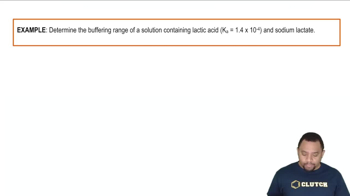
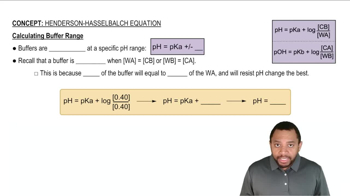
Buffer Range Calculation
3221
views
27
rank
VideoThumbView.guidedCourse
01:22
Buffering Range Example
2665
views
30
rank
1
comments
VideoThumbView.guidedCourse
02:40
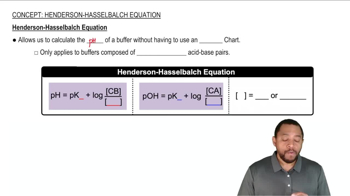
Henderson-Hasselbalch Equation
4315
views
38
rank
2
comments
이 집합의 용어 (15)
하이드의 정의
What does the Henderson-Hasselbalch equation allow you to calculate?
It allows you to calculate the pH of a buffer solution without using an ICE chart.
For which type of solutions does the Henderson-Hasselbalch equation apply?
It applies to buffer solutions composed of a conjugate acid-base pair.
What is the Henderson-Hasselbalch equation when given the acid dissociation constant (Ka)?
The equation is pH = pKa + log([conjugate base]/[weak acid]).
What is the Henderson-Hasselbalch equation when given the base dissociation constant (Kb)?
The equation is pH = pKb + log([conjugate acid]/[weak base]).
What do the brackets in the Henderson-Hasselbalch equation represent?
The brackets represent either the molarity (concentration) or the moles of the components.
When is a buffer considered ideal according to the Henderson-Hasselbalch equation?
A buffer is ideal when the concentrations of weak acid and conjugate base (or weak base and conjugate acid) are equal.
What does the Henderson-Hasselbalch equation simplify to in an ideal buffer?
It simplifies to pH = pKa (or pH = pKb) when the concentrations are equal.
What is the value of log(1) in the Henderson-Hasselbalch equation, and why is it important?
Log(1) equals 0, which means the equation simplifies to pH = pKa or pH = pKb in an ideal buffer.
What is the effective pH range for a buffer according to the Henderson-Hasselbalch equation?
The effective range is pH = pKa ± 1, where the buffer best resists changes in pH.
Why are buffers most effective within the range of pKa ± 1?
Because within this range, the buffer can best resist sharp changes in pH.
What happens to the pH of a buffer when the concentrations of conjugate base and weak acid are equal?
The pH equals the pKa of the weak acid.
Can you use moles instead of molarity in the Henderson-Hasselbalch equation?
Yes, you can use either moles or molarity in the equation.
What is the mathematical relationship between moles, liters, and molarity?
Moles equal liters times molarity.
If you are given Kb instead of Ka, which version of the Henderson-Hasselbalch equation should you use?
You should use pH = pKb + log([conjugate acid]/[weak base]).
Why is it important to know the effective range of a buffer?
It helps in preparing buffer solutions that maintain a stable pH in various chemical applications.
 뒤로뒤로
뒤로뒤로
 02:47
02:47