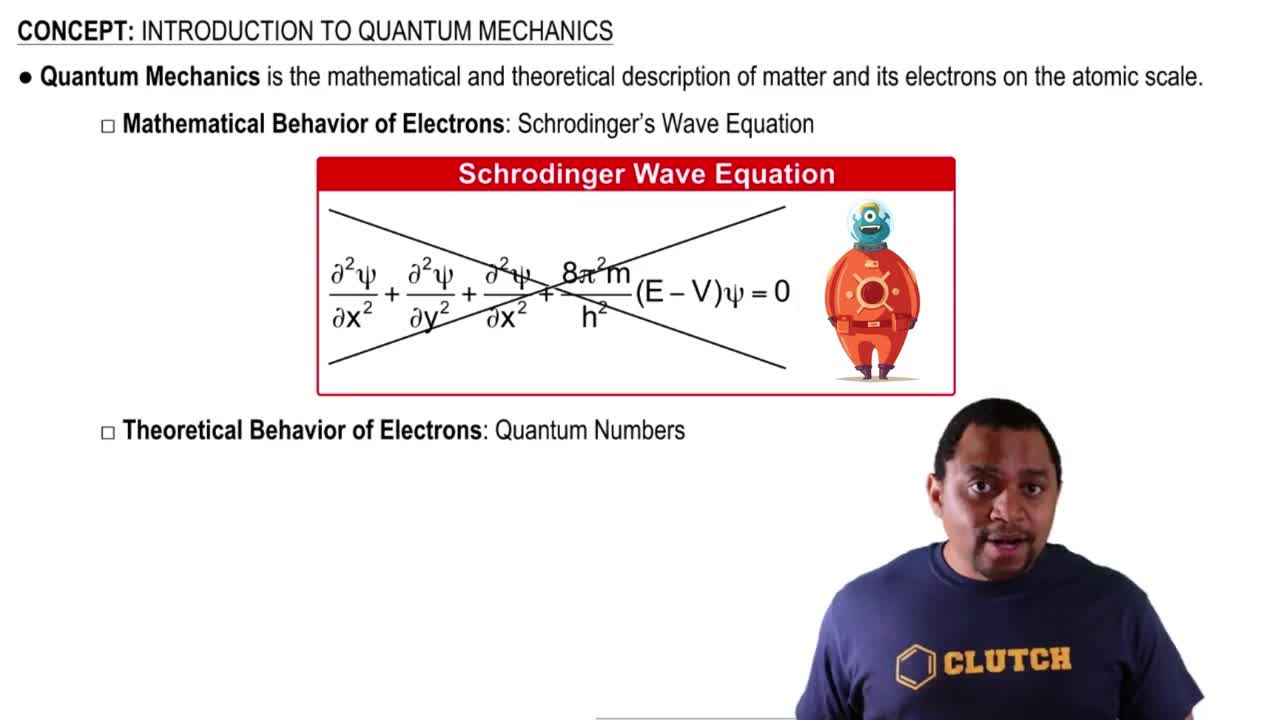
What does quantum mechanics describe at the atomic scale?
Quantum mechanics describes the behavior of electrons and matter at the atomic scale.
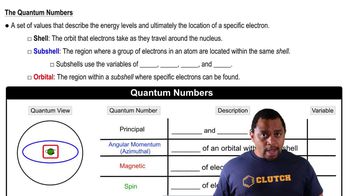
What is the purpose of quantum numbers in quantum mechanics?
Quantum numbers specify the energy levels and positions of electrons within an atom.
What does the principal quantum number (n) indicate?
The principal quantum number indicates the energy and size of an atomic shell.
Which quantum number defines the shape of an orbital within a subshell?
The angular momentum quantum number (l), also called the azimuthal quantum number, defines the shape of an orbital.
What does the magnetic quantum number (ml) specify?
The magnetic quantum number specifies the orientation and location of an electron within a set of orbitals.
What information does the spin quantum number (ms) provide?
The spin quantum number determines the direction of an electron's spin within an orbital.
What is the order of specificity when locating an electron using quantum numbers?
We start with the atom, then the shell, subshell, orbital, and finally the specific electron.
What are the possible variables used for subshells?
Subshells use the variables s, p, d, and f.
How many quantum numbers are needed to specify an electron's location in an atom?
Four quantum numbers are needed to specify an electron's location.
What is the variable used for the principal quantum number?
The variable used for the principal quantum number is n.
What is the variable used for the angular momentum quantum number?
The variable used for the angular momentum quantum number is l.
What is the variable used for the magnetic quantum number?
The variable used for the magnetic quantum number is ml.
What is the variable used for the spin quantum number?
The variable used for the spin quantum number is ms.
Why is understanding quantum numbers important in chemistry?
Understanding quantum numbers is essential for grasping the complex behavior of electrons, which influences the chemical and physical properties of elements.
What is the relationship between shells, subshells, and orbitals?
Shells contain subshells, subshells contain orbitals, and orbitals are regions where specific electrons are found.
 뒤로
뒤로

 00:46
00:46