Skip to main content
General Chemistry
나의 코스
배우기
시험 준비
AI 튜터
학습 가이드
교과서적 해결책
플래시카드
탐험해 보세요
앱을 사용해 보세요
나의 코스
배우기
시험 준비
AI 튜터
학습 가이드
교과서적 해결책
플래시카드
탐험해 보세요
앱을 사용해 보세요
뒤로
Kinetic Molecular Theory quiz
카드를 뒤집기 위해 탭할 수 있습니다.
What drives the process of diffusion?
카드를 뒤집기 위해 탭할 수 있습니다.
👆
What drives the process of diffusion?
Diffusion is driven by concentration gradients.
진행 상황 추적
컨트롤 버튼이 '내비게이션' 모드로 변경되었습니다.
1/10
관련 플래시카드
관련 실천
추천 영상
Kinetic Molecular Theory definitions
Kinetic Molecular Theory
15 용어
Kinetic Molecular Theory quiz #1
Kinetic Molecular Theory
39 용어
Kinetic Molecular Theory quiz #2
Kinetic Molecular Theory
38 용어
Kinetic Molecular Theory
7. Gases
6 문제점
주제
Jules
Van der Waals Equation
7. Gases
5 문제점
주제
Jules
7. Gases - Part 1 of 4
5 주제
14 문제점
장
Jules
7. Gases - Part 2 of 4
5 주제
13 문제점
장
Jules
7. Gases - Part 3 of 4
5 주제
13 문제점
장
Jules
7. Gases - Part 4 of 4
5 주제
13 문제점
장
Jules
VideoThumbView.guidedCourse
02:13
Ideal Gas Conditions Example
5881
views
31
rank
2
comments
VideoThumbView.guidedCourse
01:19
Kinetic Molecular Theory
6436
views
39
rank
VideoThumbView.guidedCourse
03:23
Kinetic Molecular Theory Postulates
6331
views
34
rank
이 집합의 용어 (10)
하이드의 정의
What drives the process of diffusion?
Diffusion is driven by concentration gradients.
What happens to the rate of diffusion with temperature?
The rate of diffusion increases with temperature because higher temperatures increase the velocity of gas molecules.
Will a higher rate of diffusion occur in cold or hot temperatures?
A higher rate of diffusion occurs in hot temperatures due to increased molecular velocity.
In what direction do particles naturally diffuse?
Particles naturally diffuse from areas of higher concentration to areas of lower concentration.
In which state of matter is diffusion faster, gases or liquids?
Diffusion is faster in gases than in liquids.
What drives diffusion?
Diffusion is driven by the random motion of particles and concentration gradients.
How can the speed of solvent molecules be slowed down?
The speed of solvent molecules can be slowed down by decreasing the temperature, which reduces their kinetic energy.
What is the significance of elastic collisions in the Kinetic Molecular Theory?
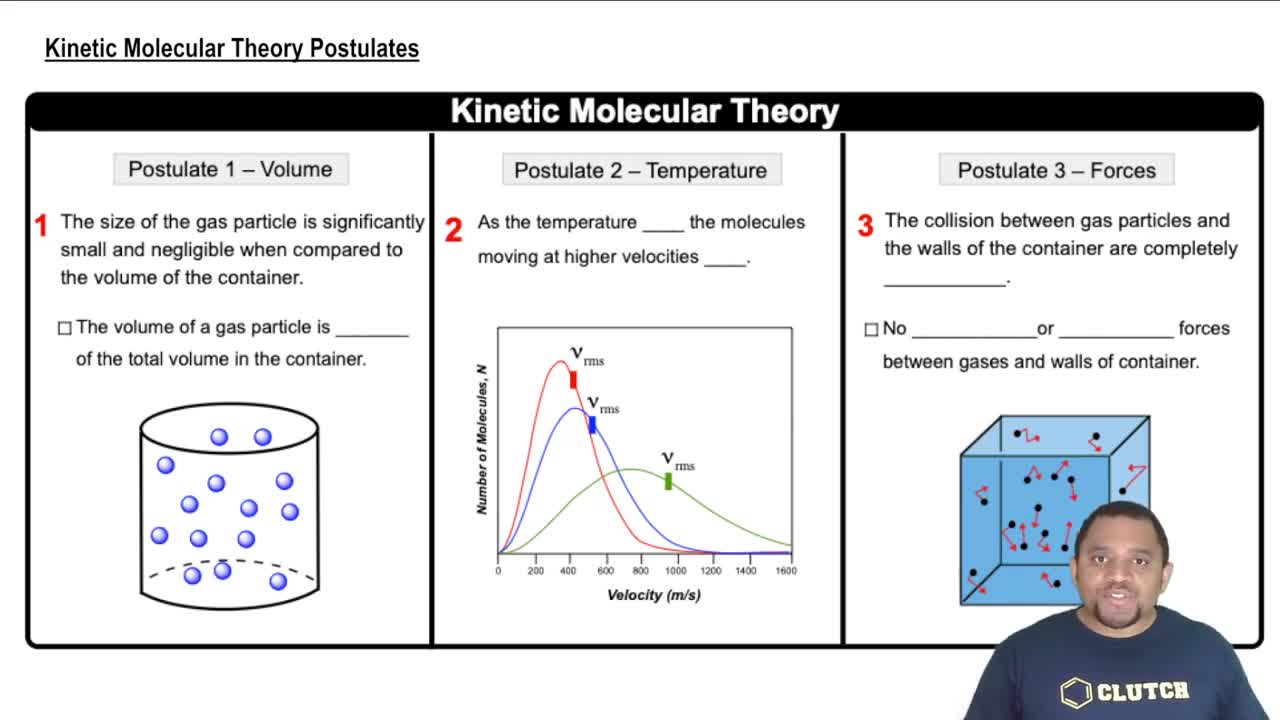
Elastic collisions mean that gas particles do not lose energy upon colliding with container walls, maintaining constant energy levels.
How does the Kinetic Molecular Theory explain the behavior of ideal gases?
The theory uses real gas data to predict ideal gas behavior, assuming negligible volume and no intermolecular forces.
What is the relationship between temperature and molecular velocity according to the Kinetic Molecular Theory?
As temperature increases, molecular velocity increases, as illustrated by the root mean square speed.
 뒤로뒤로
뒤로뒤로

 02:13
02:13