Skip to main content
General Chemistry
나의 코스
배우기
시험 준비
AI 튜터
학습 가이드
교과서적 해결책
플래시카드
탐험해 보세요
앱을 사용해 보세요
나의 코스
배우기
시험 준비
AI 튜터
학습 가이드
교과서적 해결책
플래시카드
탐험해 보세요
앱을 사용해 보세요
뒤로
Kinetic & Potential Energy quiz
카드를 뒤집기 위해 탭할 수 있습니다.
What is the formula for calculating kinetic energy?
카드를 뒤집기 위해 탭할 수 있습니다.
👆
What is the formula for calculating kinetic energy?
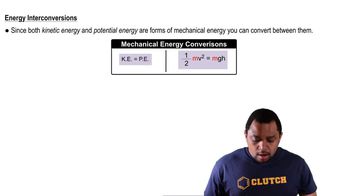
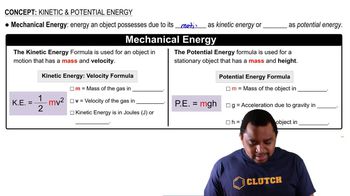
Kinetic energy (KE) is calculated as KE = 1/2 m v^2, where m is mass in kilograms and v is velocity in meters per second.
진행 상황 추적
컨트롤 버튼이 '내비게이션' 모드로 변경되었습니다.
1/15
관련 플래시카드
관련 실천
추천 영상
Kinetic & Potential Energy definitions
Kinetic & Potential Energy
10 용어
Kinetic & Potential Energy quiz
Kinetic & Potential Energy
10 용어
Kinetic & Potential Energy quiz #1
Kinetic & Potential Energy
10 용어
Kinetic & Potential Energy
8. Thermochemistry
5 문제점
주제
Jules
First Law of Thermodynamics -
8. Thermochemistry
6 문제점
주제
Jules
8. Thermochemistry - Part 1 of 3
5 주제
13 문제점
장
Jules
8. Thermochemistry - Part 2 of 3
5 주제
13 문제점
장
Jules
8. Thermochemistry - Part 3 of 3
5 주제
13 문제점
장
Jules
VideoThumbView.guidedCourse
01:59
Kinetic & Potential Energy
8268
views
77
rank
1
comments
VideoThumbView.guidedCourse
00:34
Kinetic & Potential Energy
4956
views
51
rank
1
comments
VideoThumbView.guidedCourse
02:25
Kinetic & Potential Energy Example 2
4713
views
100
rank
2
comments
이 집합의 용어 (15)
하이드의 정의
What is the formula for calculating kinetic energy?
Kinetic energy (KE) is calculated as KE = 1/2 m v^2, where m is mass in kilograms and v is velocity in meters per second.
What does the 'm' represent in the kinetic energy formula?
'm' represents the mass of the object, measured in kilograms.
In the kinetic energy formula, what does 'v' stand for and what are its units?
'v' stands for velocity, and its units are meters per second (m/s).
What are the units of kinetic energy?
Kinetic energy is measured in joules (J), which are equivalent to kg·m^2/s^2.
What is the formula for potential energy?
Potential energy (PE) is calculated as PE = mgh, where m is mass, g is acceleration due to gravity, and h is height.
What value is typically used for 'g', the acceleration due to gravity, on Earth?
On Earth, 'g' is typically 9.8 meters per second squared (m/s^2).
What does 'h' represent in the potential energy formula?
'h' represents the height of the object above a reference point, measured in meters.
How are kinetic energy and potential energy related to mechanical energy?
Mechanical energy is the sum of kinetic energy and potential energy in an object.
Can kinetic energy be converted into potential energy and vice versa?
Yes, kinetic energy and potential energy are interconvertible forms of mechanical energy.
What is the abbreviation for kinetic energy and potential energy?
Kinetic energy is abbreviated as KE, and potential energy is abbreviated as PE.
If an object is stationary but elevated, which type of energy does it primarily have?
A stationary but elevated object primarily has potential energy.
If an object is moving, which type of energy does it possess?
A moving object possesses kinetic energy.
What is the equation that shows the conversion between kinetic and potential energy?
The conversion is shown as 1/2 m v^2 = mgh, where kinetic energy equals potential energy.
What are the SI units for mass, velocity, and height in the energy formulas?
Mass is in kilograms (kg), velocity in meters per second (m/s), and height in meters (m).
Why is understanding kinetic and potential energy important in science?
Understanding these energies and their formulas is crucial for converting between them and forms the foundation for physics and other sciences.
 뒤로뒤로
뒤로뒤로
 01:59
01:59