Skip to main content
General Chemistry
나의 코스
배우기
시험 준비
AI 튜터
학습 가이드
교과서적 해결책
플래시카드
탐험해 보세요
앱을 사용해 보세요
나의 코스
배우기
시험 준비
AI 튜터
학습 가이드
교과서적 해결책
플래시카드
탐험해 보세요
앱을 사용해 보세요
뒤로
Logarithmic Functions quiz
카드를 뒤집기 위해 탭할 수 있습니다.
What does log(10) equal and why?
카드를 뒤집기 위해 탭할 수 있습니다.
👆
What does log(10) equal and why?
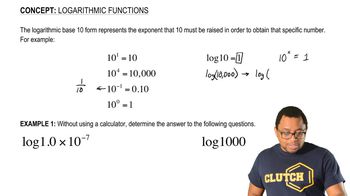
Log(10) equals 1 because 10 raised to the power of 1 is 10.
진행 상황 추적
컨트롤 버튼이 '내비게이션' 모드로 변경되었습니다.
1/15
관련 플래시카드
관련 실천
추천 영상
Power and Root Functions definitions
Logarithmic Functions
15 용어
Power and Root Functions quiz #1
Logarithmic Functions
21 용어
Logarithmic Functions
5. BONUS: Mathematical Operations and Functions
10 문제점
주제
The Quadratic Formula
5. BONUS: Mathematical Operations and Functions
10 문제점
주제
5. BONUS: Mathematical Operations and Functions
5 주제
15 문제점
장
VideoThumbView.guidedCourse
04:24
Inverse Logarithmic Functions
4608
views
8
rank
1
comments
VideoThumbView.guidedCourse
02:16
Logarithmic Functions Example
3705
views
8
rank
VideoThumbView.guidedCourse
03:37
Logarithmic Functions
4338
views
5
rank
1
comments
이 집합의 용어 (15)
하이드의 정의
What does log(10) equal and why?
Log(10) equals 1 because 10 raised to the power of 1 is 10.
How do you express log(10000) in terms of exponents, and what is its value?
Log(10000) is log(10^4), which equals 4 because 10 to the 4th power is 10000.
What is the value of log(0.10) and how is it derived?
Log(0.10) equals -1 because 0.10 is 10 to the power of -1.
Why does log(1) always equal 0?
Log(1) equals 0 because any number raised to the power of 0 is 1.
What is the antilog of a number y if log(x) = y?
The antilog is 10^y, which gives back the original number x.
How is the antilog function used in the Henderson-Hasselbalch equation?
The antilog is used to solve for the ratio of conjugate base to weak acid by raising 10 to the power of the difference between pH and pKa.
What does the natural logarithm (ln) of a number represent?
The natural logarithm of a number is the power to which e must be raised to yield that number.
If ln(x) = y, what is the value of x?
x equals e^y, which is the inverse of the natural logarithm.
How do you simplify log(a × b) using logarithm properties?
Log(a × b) simplifies to log(a) + log(b).
What is the logarithmic property for division, log(a/b)?
Log(a/b) equals log(a) minus log(b).
How do you handle exponents in logarithms, such as log(a^x)?
Log(a^x) equals x times log(a); the exponent moves in front of the log.
How do you express the logarithm of an nth root, such as log(a^(1/x))?
Log(a^(1/x)) equals (1/x) times log(a).
If log(3) ≈ 0.48 and log(2) ≈ 0.30, how can you find log(12) without a calculator?
Log(12) = log(3) + log(2) + log(2) = 0.48 + 0.30 + 0.30 = 1.08.
When solving ln(x) = value, what operation do you perform to find x?
Take the exponential (e to the power of the value) to solve for x.
In what chemistry topic are natural logarithms (ln) commonly used?
Natural logarithms are commonly used in chemical kinetics.
 뒤로뒤로
뒤로뒤로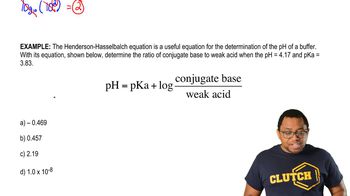
 04:24
04:24