Skip to main content
General Chemistry
나의 코스
배우기
시험 준비
AI 튜터
학습 가이드
교과서적 해결책
플래시카드
탐험해 보세요
앱을 사용해 보세요
나의 코스
배우기
시험 준비
AI 튜터
학습 가이드
교과서적 해결책
플래시카드
탐험해 보세요
앱을 사용해 보세요
뒤로
Mass Defect definitions
카드를 뒤집기 위해 탭할 수 있습니다.
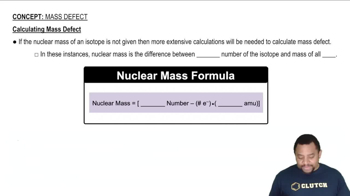
Mass Defect
카드를 뒤집기 위해 탭할 수 있습니다.
👆
Mass Defect
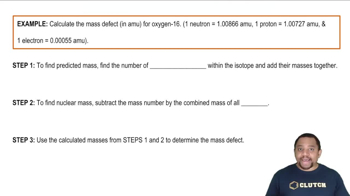
Difference between predicted mass of an isotope and its actual nuclear mass due to energy conversion.
진행 상황 추적
컨트롤 버튼이 '내비게이션' 모드로 변경되었습니다.
1/15
관련 플래시카드
관련 실천
추천 영상
Mass Defect quiz #1
Mass Defect
10 용어
Mass Defect quiz
Mass Defect
15 용어
Mass Defect
21. Nuclear Chemistry
3 문제점
주제
Jules
Nuclear Binding Energy
21. Nuclear Chemistry
4 문제점
주제
Jules
21. Nuclear Chemistry - Part 1 of 3
5 주제
11 문제점
장
Jules
21. Nuclear Chemistry - Part 2 of 3
5 주제
10 문제점
장
Jules
21. Nuclear Chemistry - Part 3 of 3
5 주제
13 문제점
장
Jules
VideoThumbView.guidedCourse
01:35
Mass Defect Example
1551
views
3
rank
VideoThumbView.guidedCourse
00:55
Calculating Mass Defect
1491
views
3
rank
VideoThumbView.guidedCourse
03:08
Calculating Mass Defect Example
1220
views
3
rank
이 집합의 용어 (15)
하이드의 정의
Mass Defect
Difference between predicted mass of an isotope and its actual nuclear mass due to energy conversion.
Predicted Mass
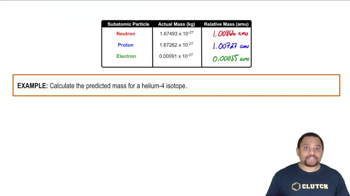
Sum of the masses of all subatomic particles in an element before isotope formation.
Nuclear Mass
Actual mass of an isotope's nucleus, found on the periodic table as atomic mass.
Subatomic Particles
Constituents of an atom, including neutrons, protons, and electrons.
Neutron
Subatomic particle with a mass of 1.00866 amu, found in the nucleus.
Proton
Subatomic particle with a mass of 1.00727 amu, found in the nucleus.
Electron
Subatomic particle with a mass of 0.00055 amu, orbiting the nucleus.
Atomic Mass Unit
Unit of mass equal to 1.66 x 10^-27 kilograms, used for subatomic particles.
First Law of Thermodynamics
Principle stating energy cannot be created or destroyed, only transformed.
Energy Conversion
Process where mass lost during isotope formation is transformed into energy.
E=mc^2
Einstein's equation relating mass and energy, allowing conversion between the two.
Isotope
Variant of an element with a specific number of neutrons and protons in the nucleus.
Mass Number
Total number of protons and neutrons in an atom's nucleus.
Atomic Mass
Mass of an atom, typically found on the periodic table, representing nuclear mass.
Energy Absorption
Process where energy is used to break an isotope into its subatomic particles.
 뒤로뒤로
뒤로뒤로
 01:35
01:35