Skip to main content
General Chemistry
나의 코스
배우기
시험 준비
AI 튜터
학습 가이드
교과서적 해결책
플래시카드
탐험해 보세요
앱을 사용해 보세요
나의 코스
배우기
시험 준비
AI 튜터
학습 가이드
교과서적 해결책
플래시카드
탐험해 보세요
앱을 사용해 보세요
뒤로
Nature of Energy quiz #1
카드를 뒤집기 위해 탭할 수 있습니다.
What happens every time energy changes form?
카드를 뒤집기 위해 탭할 수 있습니다.
👆
What happens every time energy changes form?
Whenever energy changes form, some energy may be lost as heat, and the total energy is conserved but may become less useful for doing work.
진행 상황 추적
컨트롤 버튼이 '내비게이션' 모드로 변경되었습니다.
1/40
관련 플래시카드
관련 실천
추천 영상
Nature of Energy definitions
Nature of Energy
13 용어
Nature of Energy quiz
Nature of Energy
35 용어
Nature of Energy quiz #2
Nature of Energy
40 용어
Nature of Energy
8. Thermochemistry
5 문제점
주제
Jules
Kinetic & Potential Energy
8. Thermochemistry
5 문제점
주제
Jules
8. Thermochemistry - Part 1 of 3
5 주제
13 문제점
장
Jules
8. Thermochemistry - Part 2 of 3
5 주제
13 문제점
장
Jules
8. Thermochemistry - Part 3 of 3
5 주제
13 문제점
장
Jules
VideoThumbView.guidedCourse
01:26
Nature of Energy
15607
views
282
rank
VideoThumbView.guidedCourse
01:32
Nature of Energy Example 1
12438
views
161
rank
1
comments
VideoThumbView.guidedCourse
01:14
Nature of Energy
13204
views
172
rank
2
comments
이 집합의 용어 (40)
하이드의 정의
What happens every time energy changes form?
Whenever energy changes form, some energy may be lost as heat, and the total energy is conserved but may become less useful for doing work.
Which best explains the relationship between evaporation and temperature?
As temperature increases, the rate of evaporation increases because particles have more kinetic energy to escape the liquid phase.
Which substance has the most thermal energy and will have the most heat flow from it?
The substance with the highest temperature and largest mass will have the most thermal energy and the greatest potential for heat flow.
What happens to the particles of a liquid when energy is removed from them?
When energy is removed, the particles slow down, and the liquid may cool or freeze as particle motion decreases.
What happens when molecules gain energy?
When molecules gain energy, their motion increases, which can raise temperature or cause a change in state.
What is the branch of chemistry concerned with energy changes?
Thermochemistry is the branch of chemistry concerned with energy changes.
What is the sequence of energy transformations in a process: chemical to thermal to electrical current?
Chemical energy is converted to thermal energy, which is then transformed into electrical energy.
Why does a solid change to liquid when heat is added?
Adding heat increases particle motion, eventually overcoming intermolecular forces and causing the solid to melt into a liquid.
Which type of energy level is least stable?
High potential energy levels are least stable because systems tend to move toward lower energy states.
What change takes place in a substance as the molecular motion of that substance increases?
As molecular motion increases, temperature rises and the substance may change state (e.g., solid to liquid).
What is the true definition of energy in chemistry?
Energy is the capacity to do work or produce heat and is conserved in all processes.
Which form of energy is converted to thermal energy when propane burns in air?
Chemical energy in propane is converted to thermal energy during combustion.
What is the difference between heat and thermal energy?
Thermal energy is the total kinetic energy of particles in a substance; heat is the transfer of thermal energy between objects.
What is chemical energy?
Chemical energy is potential energy stored in chemical bonds, released or absorbed during chemical reactions.
Which energy transformations occur when a candle burns?
Chemical energy in the wax is transformed into thermal energy and light energy.
How is energy involved in melting?
Energy is absorbed by a solid during melting, increasing particle motion and breaking intermolecular forces.
Which thermodynamic quantity is a state function?
Enthalpy is a state function, depending only on the initial and final states, not the path taken.
What is an example of chemical energy?
Food, batteries, and fuels like gasoline are examples of chemical energy.
What is an example of chemical energy?
A battery storing energy or gasoline in a car are examples of chemical energy.
Which type of energy is stored in chemical compounds and released in chemical reactions?
Chemical energy is stored in chemical compounds and released during reactions.
Which compound would you predict to be highest in energy?
Compounds with many unstable or strained bonds, such as gasoline, typically have high chemical energy.
What is similar about the energy changes in the two reactions?
Both reactions involve the transformation of chemical energy into other forms, such as thermal energy.
Which term is a measure of the energy required to increase the surface area of a liquid?
Surface tension measures the energy required to increase the surface area of a liquid.
Which form of energy changes in chemical reactions due to bonds breaking and forming?
Chemical energy changes during chemical reactions as bonds break and form.
What types of materials contain chemical energy?
Fuels, food, and batteries all contain chemical energy.
What three processes cause fireworks to emit light?
Combustion, excitation of atoms, and emission of light cause fireworks to emit light.
How is chemical energy defined?
Chemical energy is the potential energy stored in chemical bonds, released or absorbed during reactions.
Why does a liquid's rate of evaporation increase when the liquid is heated?
Heating increases particle kinetic energy, allowing more particles to escape as vapor.
What is the energy transformation of lighting a match?
Lighting a match transforms chemical energy into thermal energy and light energy.
How much energy is required to convert 50.0 g of water at 100°C to 50.0 g of steam at 100°C?
The energy required is the mass multiplied by the heat of vaporization of water: 50.0 g × 2260 J/g = 113,000 J.
How many joules are in 55.2 calories?
55.2 calories × 4.184 J/cal = 231 J.
Which term refers to the energy needed to get a chemical reaction started?
Activation energy is the energy needed to start a chemical reaction.
Where is chemical energy contained in a compound?
Chemical energy is stored in the chemical bonds between atoms in a compound.
What is the difference between kilocalories and calories?
One kilocalorie (food Calorie) equals 1,000 calories; kilocalories are used in nutrition, calories in chemistry.
What has occurred when bubbles form in a liquid that is being heated?
Bubbles indicate the liquid is boiling and vapor is forming.
What is significant about the temperature absolute zero?
At absolute zero, particle motion stops and thermal energy is minimal.
Why does evaporation cool the liquid left behind?
Evaporation removes high-energy particles, lowering the average energy and cooling the liquid.
How does heat differ from thermal energy?
Heat is energy transferred between objects; thermal energy is the total kinetic energy of particles in a substance.
What units are used to measure energy?
Energy is measured in joules, calories, and kilowatt-hours.
What unit is used to measure energy?
The standard unit for energy is the joule (J).
 뒤로
뒤로
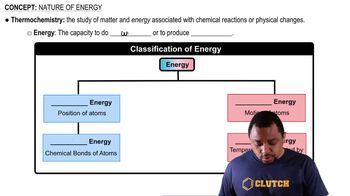
 01:26
01:26