Skip to main content
General Chemistry
나의 코스
배우기
시험 준비
AI 튜터
학습 가이드
교과서적 해결책
플래시카드
탐험해 보세요
앱을 사용해 보세요
나의 코스
배우기
시험 준비
AI 튜터
학습 가이드
교과서적 해결책
플래시카드
탐험해 보세요
앱을 사용해 보세요
뒤로
Rate Law quiz #1
카드를 뒤집기 위해 탭할 수 있습니다.
What are the units for the rate constant of a first-order reaction?
카드를 뒤집기 위해 탭할 수 있습니다.
👆
What are the units for the rate constant of a first-order reaction?
The units for the rate constant (k) of a first-order reaction are 1/time, such as s⁻¹ or min⁻¹.
진행 상황 추적
컨트롤 버튼이 '내비게이션' 모드로 변경되었습니다.
1/33
관련 플래시카드
관련 실천
추천 영상
Rate Law definitions
Rate Law
10 용어
Rate Law quiz
Rate Law
15 용어
Rate Law
15. Chemical Kinetics
7 문제점
주제
Jules
Reaction Mechanism
15. Chemical Kinetics
7 문제점
주제
Jules
15. Chemical Kinetics - Part 1 of 3
5 주제
12 문제점
장
Jules
15. Chemical Kinetics - Part 2 of 3
4 주제
11 문제점
장
Jules
15. Chemical Kinetics - Part 3 of 3
4 주제
11 문제점
장
Jules
VideoThumbView.guidedCourse
01:07
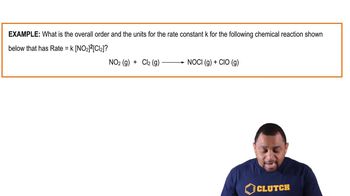
Rate Constant Units Example
6263
views
73
rank
1
comments
VideoThumbView.guidedCourse
00:45
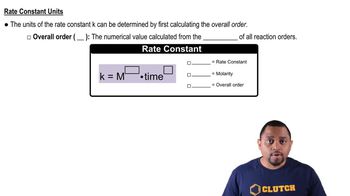
Rate Constant Units
6362
views
52
rank
3
comments
VideoThumbView.guidedCourse
07:33
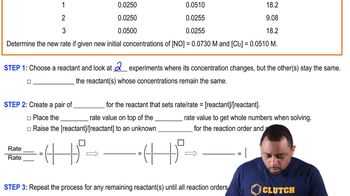
Rate Law Calculation Example
6805
views
73
rank
5
comments
이 집합의 용어 (33)
하이드의 정의
What are the units for the rate constant of a first-order reaction?
The units for the rate constant (k) of a first-order reaction are 1/time, such as s⁻¹ or min⁻¹.
What are the units for the rate constant of a reaction with the rate law rate = k[A][B]?
For the rate law rate = k[A][B], the overall order is 2, so the units for k are M⁻¹·time⁻¹ (e.g., M⁻¹·s⁻¹).
What are the units for the rate constant in a general rate law?
The units for the rate constant depend on the overall reaction order: k = M^(1-n)·time⁻¹, where n is the overall order.
What does a partial reaction order describe in a rate law?
A partial reaction order refers to the exponent of a specific reactant concentration in the rate law, determined experimentally or by mechanism.
What are the units of k for a zeroth order reaction?
For a zeroth order reaction, the units of k are M·time⁻¹ (e.g., M/s or M/min).
What is the rate law for the uncatalyzed reaction?
The rate law for an uncatalyzed reaction is determined experimentally and generally takes the form rate = k[reactant]^order.
What are the units of the rate constant k for this reaction?
The units of k depend on the overall reaction order; use k = M^(1-n)·time⁻¹, where n is the sum of reaction orders.
What is the rate law for the reaction: A + B → C?
The rate law for A + B → C is rate = k[A]^x[B]^y, where x and y are determined experimentally or by mechanism.
What are the units of k in the following rate law? rate = k[X][Y]^(1/2)
The overall order is 1.5, so the units for k are M^(1-1.5)·time⁻¹ = M⁻⁰.⁵·time⁻¹.
What does the rate law for a reaction show?
The rate law shows how the rate of a reaction depends on the concentrations of reactants and their reaction orders.
If the rate = [P]^2[G][O], then what is the overall reaction order?
The overall reaction order is 2 (for P) + 1 (for G) + 1 (for O) = 4.
What are the units of k in the following rate law? rate = k[X][Y]
The overall order is 2, so the units for k are M⁻¹·time⁻¹.
Determine the rate law for the following elementary reaction: O₃(g) + O(g) → 2O₂(g)
For an elementary reaction, the rate law is rate = k[O₃][O].
What are the units of a second-order rate constant?
For a second-order reaction, the rate constant units are M⁻¹·time⁻¹.
What are the units of k in the following rate law? rate = k[X]^0[Y]^0
The overall order is 0, so the units for k are M·time⁻¹.
What are reasonable units for the rate constant of a zero order reaction?
A reasonable unit for a zero order rate constant is M/s or M/min.
What does the rate law express about the dependence of reaction rate on reactant concentrations?
The rate law shows how rate depends on reactant concentrations: rate = k[A]^x[B]^y.
What is the reaction order with respect to A?
The reaction order with respect to A is the exponent of [A] in the rate law, determined experimentally or by mechanism.
Considering the rate law, what is the significance of the exponents?
The exponents in the rate law represent the reaction order for each reactant, indicating how the rate depends on their concentrations.
What is the rate law for the reaction A → B if the rate constant is given?
The rate law is rate = k[A]^n, where n is the reaction order determined experimentally.
The reaction 2W + X → Y + Z has the mechanism shown below. What is the rate law for this reaction?
The rate law is determined by the slowest step in the mechanism and generally takes the form rate = k[W]^x[X]^y, with x and y from the mechanism.
What are the units of k in the following rate law? rate = k[X]^2[Y]^2
The overall order is 4, so the units for k are M⁻³·time⁻¹.
How is the rate of appearance of ClO₂⁻(aq) expressed in terms of concentration change over time?
The rate of appearance of ClO₂⁻(aq) is given by the change in its concentration over time: rate = Δ[ClO₂⁻]/Δt.
What is the rate for the second order reaction A → products when [A] = 0.201 M? (k = 0.761 M⁻¹·s⁻¹)
Rate = k[A]^2 = 0.761 × (0.201)^2 = 0.0308 M/s.
What is the rate for the zero order reaction A → products when [A] = 0.200 M? (k = 3.57 M/min)
Rate = k = 3.57 M/min (for zero order, rate is independent of [A]).
The exponents in a rate law can be found:
The exponents (reaction orders) are found experimentally or from the reaction mechanism.
What is the rate law for the reaction A → B if the rate constant, k, is 0.25 M⁻¹·s⁻¹ at 75°C?
If k has units M⁻¹·s⁻¹, the rate law is rate = k[A]^2 (second order with respect to A).
If the reaction X + 2Y → XY₂ occurs by the proposed mechanism, what is the rate law?
The rate law is determined by the slowest step; for an elementary reaction, rate = k[X][Y]^2.
What are the units for the rate constant of a reaction with the rate law, rate = k[A][B]?
For rate = k[A][B], the units for k are M⁻¹·time⁻¹.
What is the overall reaction order for the following rate law: rate = k[A][B][C]^2?
The overall reaction order is 1 (A) + 1 (B) + 2 (C) = 4.
The rate constant for this first order reaction is:
For a first order reaction, the rate constant has units of 1/time (e.g., s⁻¹).
Consider the reaction and its rate law. What information does the rate law provide?
The rate law provides the relationship between reactant concentrations and the reaction rate, including reaction orders.
Write the rate law for the reaction between HCl and Na₂S₂O₃.
The rate law is rate = k[HCl]^x[Na₂S₂O₃]^y, where x and y are determined experimentally.
 뒤로
뒤로
 01:07
01:07