Skip to main content
General Chemistry
나의 코스
배우기
시험 준비
AI 튜터
학습 가이드
교과서적 해결책
플래시카드
탐험해 보세요
앱을 사용해 보세요
나의 코스
배우기
시험 준비
AI 튜터
학습 가이드
교과서적 해결책
플래시카드
탐험해 보세요
앱을 사용해 보세요
뒤로
Rate of Radioactive Decay quiz
카드를 뒤집기 위해 탭할 수 있습니다.
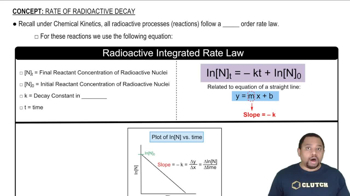
What order of rate law do all radioactive decay processes follow?
카드를 뒤집기 위해 탭할 수 있습니다.
👆
What order of rate law do all radioactive decay processes follow?
All radioactive decay processes follow a first-order rate law.
진행 상황 추적
컨트롤 버튼이 '내비게이션' 모드로 변경되었습니다.
1/15
관련 플래시카드
관련 실천
추천 영상
Rate of Radioactive Decay definitions
Rate of Radioactive Decay
15 용어
Rate of Radioactive Decay
21. Nuclear Chemistry
3 문제점
주제
Jules
Radioactive Half-Life
21. Nuclear Chemistry
5 문제점
주제
Jules
21. Nuclear Chemistry - Part 1 of 3
5 주제
11 문제점
장
Jules
21. Nuclear Chemistry - Part 2 of 3
5 주제
10 문제점
장
Jules
21. Nuclear Chemistry - Part 3 of 3
5 주제
13 문제점
장
Jules
VideoThumbView.guidedCourse
02:25
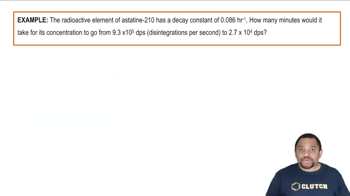
Rate of Radioactive Decay Example
1389
views
4
rank
VideoThumbView.guidedCourse
03:00
Rate of Radioactive Decay
1485
views
5
rank
이 집합의 용어 (15)
하이드의 정의
What order of rate law do all radioactive decay processes follow?
All radioactive decay processes follow a first-order rate law.
What is the integrated rate law equation for radioactive decay?
The integrated rate law is ln(N) = -kt + ln(N0), where N is the final amount, N0 is the initial amount, k is the decay constant, and t is time.
In the radioactive decay equation, what does N represent?
N represents the final amount of radioactive nuclei remaining after time t.
What does N0 (N naught) stand for in the integrated rate law?
N0 is the initial amount of radioactive nuclei present at time zero.
What is the meaning of the decay constant k in the context of radioactive decay?
The decay constant k represents the probability per unit time that a nucleus will decay; its units are inverse time.
How must the units of time and the decay constant k relate to each other?
The units of time must match the inverse units of the decay constant k (e.g., if k is in days⁻¹, time must be in days).
What does the negative sign in the equation ln(N) = -kt + ln(N0) indicate?
The negative sign indicates that the amount of radioactive nuclei decreases over time.
How is the radioactive decay equation similar to the equation of a straight line?
It is similar because ln(N) = -kt + ln(N0) matches the form y = mx + b, with y as ln(N), m as -k, x as t, and b as ln(N0).
What is plotted on the y-axis and x-axis when graphing radioactive decay using the integrated rate law?
The y-axis is ln(N) (natural log of the final concentration), and the x-axis is time.
What does the slope of the line represent in a plot of ln(N) versus time?
The slope of the line is equal to -k, the negative decay constant.
What does the intercept (b) represent in the straight-line form of the radioactive decay equation?
The intercept b is ln(N0), the natural log of the initial amount of radioactive nuclei.
Besides molarity, what other units can be used for N and N0 in radioactive decay?
N and N0 can be expressed in units such as disintegrations per second, not just molarity.
How do you calculate the change in the natural log of concentration over time on a graph?
It is calculated as the change in ln(N) divided by the change in time (Δy/Δx).
Why is it important to remember the radioactive integrated rate law equation?
Because it is the primary equation used to analyze and solve problems involving radioactive decay.
What is the general trend of the graph of ln(N) versus time for radioactive decay?
The graph shows a straight line with a negative slope, indicating a continuous decrease in radioactive nuclei over time.
 뒤로뒤로
뒤로뒤로
 02:25
02:25