Skip to main content
General Chemistry
나의 코스
배우기
시험 준비
AI 튜터
학습 가이드
교과서적 해결책
플래시카드
탐험해 보세요
앱을 사용해 보세요
나의 코스
배우기
시험 준비
AI 튜터
학습 가이드
교과서적 해결책
플래시카드
탐험해 보세요
앱을 사용해 보세요
뒤로
Intro to Chemical Kinetics quiz
카드를 뒤집기 위해 탭할 수 있습니다.
What does chemical kinetics study?
카드를 뒤집기 위해 탭할 수 있습니다.
👆
What does chemical kinetics study?
Chemical kinetics studies the factors that affect the rate or speed at which reactants are converted into products.
진행 상황 추적
컨트롤 버튼이 '내비게이션' 모드로 변경되었습니다.
1/15
관련 플래시카드
관련 실천
추천 영상
Intro to Chemical Kinetics definitions
Intro to Chemical Kinetics
11 용어
Intro to Chemical Kinetics quiz
Intro to Chemical Kinetics
10 용어
Intro to Chemical Kinetics quiz #1
Intro to Chemical Kinetics
10 용어
Intro to Chemical Kinetics
15. Chemical Kinetics
2 문제점
주제
Jules
Energy Diagrams
15. Chemical Kinetics
5 문제점
주제
Jules
15. Chemical Kinetics - Part 1 of 3
5 주제
12 문제점
장
Jules
15. Chemical Kinetics - Part 2 of 3
4 주제
11 문제점
장
Jules
15. Chemical Kinetics - Part 3 of 3
4 주제
11 문제점
장
Jules
VideoThumbView.guidedCourse
03:06
Chemical Kinetics
10125
views
302
rank
VideoThumbView.guidedCourse
01:34
Chemical Kinetics Example
8078
views
417
rank
1
comments
이 집합의 용어 (15)
하이드의 정의
What does chemical kinetics study?
Chemical kinetics studies the factors that affect the rate or speed at which reactants are converted into products.
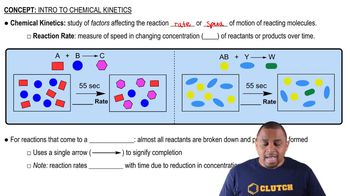
How is reaction rate defined in chemical kinetics?
Reaction rate is defined as the change in concentration of reactants or products over time.
What does it mean when a chemical species is shown in brackets, like [A]?
Brackets around a chemical species indicate its concentration in the reaction.
How can you tell if a reaction has a faster rate compared to another?
A reaction has a faster rate if it produces more product in the same amount of time compared to another reaction.
What does a single arrow in a chemical equation indicate about the reaction?
A single arrow indicates that the reaction goes to completion, meaning nearly all reactants are converted into products.
What happens to the reaction rate as the concentration of reactants decreases?
The reaction rate decreases as the concentration of reactants decreases.
Why can't a reaction continue forever?
A reaction can't continue forever because eventually all the reactants are used up, stopping the reaction.
What sets the limit on how much product can be formed in a reaction?
The amount of reactant available sets the limit on how much product can be formed.
In the example given, what indicated that reaction 1 was faster than reaction 2?
Reaction 1 produced more product in 55 seconds compared to reaction 2, indicating a faster rate.
What must happen to reactants in order to form products?
Reactants must be broken down in order to form products.
If only a small amount of product forms in a given time, what does this say about the reaction rate?
It indicates that the reaction rate is slow.
What is the relationship between the amount of reactant transformed and the reaction rate?
A greater amount of reactant transformed into product in a given time means a faster reaction rate.
What happens to the reaction rate as the reaction progresses and reactants are consumed?
The reaction rate slows down as reactants are consumed.
Why is understanding reaction rates important in chemistry?
Understanding reaction rates is crucial for predicting how chemical processes will progress under various conditions.
What does it mean for a reaction to go to completion?
It means that almost all the reactants are converted into products by the end of the reaction.
 뒤로뒤로
뒤로뒤로
 03:06
03:06