Skip to main content
General Chemistry
나의 코스
배우기
시험 준비
AI 튜터
학습 가이드
교과서적 해결책
플래시카드
탐험해 보세요
앱을 사용해 보세요
나의 코스
배우기
시험 준비
AI 튜터
학습 가이드
교과서적 해결책
플래시카드
탐험해 보세요
앱을 사용해 보세요
뒤로
Reaction Mechanism quiz
카드를 뒤집기 위해 탭할 수 있습니다.
What is a reaction mechanism in chemistry?
카드를 뒤집기 위해 탭할 수 있습니다.
👆
What is a reaction mechanism in chemistry?
A reaction mechanism is a step-by-step sequence of elementary steps that describes how an overall chemical change occurs at the molecular level.
진행 상황 추적
컨트롤 버튼이 '내비게이션' 모드로 변경되었습니다.
1/15
관련 플래시카드
관련 실천
추천 영상
Reaction Mechanism definitions
Reaction Mechanism
11 용어
Reaction Mechanism quiz #1
Reaction Mechanism
10 용어
Reaction Mechanism
15. Chemical Kinetics
7 문제점
주제
Jules
Integrated Rate Law
15. Chemical Kinetics
7 문제점
주제
Jules
15. Chemical Kinetics - Part 1 of 3
5 주제
12 문제점
장
Jules
15. Chemical Kinetics - Part 2 of 3
4 주제
11 문제점
장
Jules
15. Chemical Kinetics - Part 3 of 3
4 주제
11 문제점
장
Jules
VideoThumbView.guidedCourse
01:02
Molecularity in Reactions Example
4310
views
35
rank
VideoThumbView.guidedCourse
02:14
Reaction Mechanism Example
5216
views
55
rank
VideoThumbView.guidedCourse
01:31
Molecularity in Reactions
4576
views
41
rank
이 집합의 용어 (15)
하이드의 정의
What is a reaction mechanism in chemistry?
A reaction mechanism is a step-by-step sequence of elementary steps that describes how an overall chemical change occurs at the molecular level.
What is an elementary step in a reaction mechanism?
An elementary step is a single event in a series of reactions that shows the progress of a reaction at the molecular level.
How do you determine the overall reaction from a reaction mechanism?
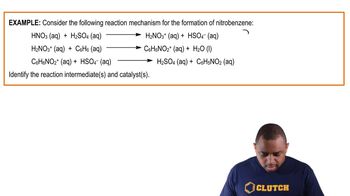
You determine the overall reaction by canceling out catalysts and reaction intermediates from the sequence of elementary steps.
What is a catalyst in the context of a reaction mechanism?
A catalyst is a compound that appears as a reactant in the first step and as a product in the final step of the mechanism.
What is a reaction intermediate?
A reaction intermediate is a compound that first appears as a product in one elementary step and later as a reactant in another step.
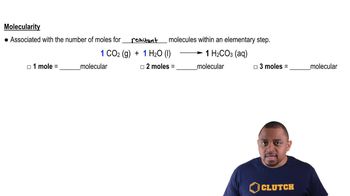
How do you identify the molecularity of an elementary step?
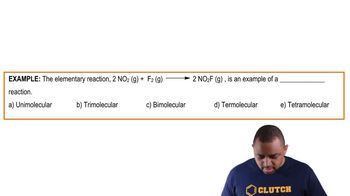
Molecularity is determined by counting the total number of reactant molecules in an elementary step.
What is a unimolecular elementary step?
A unimolecular step involves only one reactant molecule.
What is a bimolecular elementary step?
A bimolecular step involves two reactant molecules.
What is a termolecular elementary step?
A termolecular step involves three reactant molecules.
What is the rate-determining step in a reaction mechanism?
The rate-determining step is the slowest elementary step in the mechanism, which limits the overall rate of the reaction.
How are the reaction orders in the rate law related to the rate-determining step?
The coefficients of the reactants in the rate-determining step correspond to the reaction orders in the rate law.
What happens to catalysts and intermediates when writing the overall reaction?
Catalysts and intermediates are canceled out, and only the remaining species are included in the overall reaction.
Why is the rate-determining step important in kinetics?
It dictates the overall reaction rate because the reaction cannot proceed faster than its slowest step.
What prefix is used for two reactant molecules in molecularity, and why?
The prefix 'bi-' is used for two reactant molecules, not 'di-', so the step is called bimolecular.
What prefix is used for three reactant molecules in molecularity?
The prefix 'ter-' is used, so the step is called termolecular, not trimolecular.
 뒤로
뒤로
 01:02
01:02