Skip to main content
General Chemistry
나의 코스
배우기
시험 준비
AI 튜터
학습 가이드
교과서적 해결책
플래시카드
탐험해 보세요
앱을 사용해 보세요
나의 코스
배우기
시험 준비
AI 튜터
학습 가이드
교과서적 해결책
플래시카드
탐험해 보세요
앱을 사용해 보세요
뒤로
Reaction Quotient quiz
카드를 뒤집기 위해 탭할 수 있습니다.
What does the reaction quotient (Q) represent in a chemical reaction?
카드를 뒤집기 위해 탭할 수 있습니다.
👆
What does the reaction quotient (Q) represent in a chemical reaction?
Q is the ratio of product to reactant concentrations at a specific moment, not necessarily at equilibrium.
진행 상황 추적
컨트롤 버튼이 '내비게이션' 모드로 변경되었습니다.
1/15
관련 플래시카드
관련 실천
추천 영상
Reaction Quotient definitions
Reaction Quotient
15 용어
Reaction Quotient
16. Chemical Equilibrium
5 문제점
주제
Jules
ICE Charts
16. Chemical Equilibrium
7 문제점
주제
Jules
16. Chemical Equilibrium - Part 1 of 2
5 주제
13 문제점
장
Jules
16. Chemical Equilibrium - Part 2 of 2
5 주제
13 문제점
장
Jules
VideoThumbView.guidedCourse
00:49
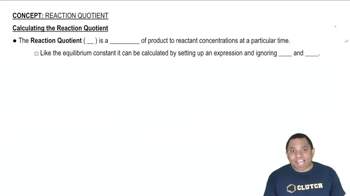
Reaction Quotient Q
3886
views
32
rank
VideoThumbView.guidedCourse
03:26
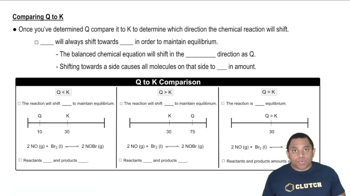
Comparing Q to K and Equilibrium Shift
3321
views
25
rank
VideoThumbView.guidedCourse
02:18
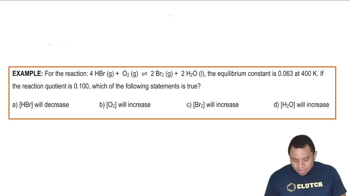
Comparing Q to K Example
2699
views
25
rank
이 집합의 용어 (15)
하이드의 정의
What does the reaction quotient (Q) represent in a chemical reaction?
Q is the ratio of product to reactant concentrations at a specific moment, not necessarily at equilibrium.
How is the reaction quotient (Q) similar to the equilibrium constant (K)?
Both Q and K are calculated using the ratio of product to reactant concentrations, ignoring solids and liquids.
What is the main difference between Q and K?
Q is calculated at any point in time, while K is calculated only at equilibrium.
What happens if Q < K for a reaction?
The reaction will shift to the right, increasing product concentration and decreasing reactant concentration to reach equilibrium.
What happens if Q > K for a reaction?
The reaction will shift to the left, increasing reactant concentration and decreasing product concentration to reach equilibrium.
What does it mean if Q = K?
The system is at equilibrium, and the concentrations of reactants and products remain constant.
When setting up the expression for Q, which phases are ignored?
Solids and liquids are ignored when calculating Q.
How does the direction of the reaction relate to the direction Q shifts to reach K?
The chemical reaction shifts in the same direction as Q moves to reach K.
If the reaction shifts toward the product side, what happens to the amounts of products and reactants?
Product amounts increase while reactant amounts decrease.
If the reaction shifts toward the reactant side, what happens to the amounts of reactants and products?
Reactant amounts increase while product amounts decrease.
Why is comparing Q to K important in chemical reactions?
It helps predict the direction the reaction will shift to reach equilibrium.
What is the value of Q if the system is at equilibrium?
Q is equal to K at equilibrium.
What happens to reactant and product concentrations when Q = K?
They remain unchanged or constant.
How can knowing Q help you in solving chemical reaction problems?
By comparing Q to K, you can determine which direction the reaction will shift to maintain equilibrium.
What is the general rule for the reaction shift when Q is not equal to K?
The reaction will always shift in the direction that brings Q closer to K.
 뒤로
뒤로
 00:49
00:49