Skip to main content
General Chemistry
나의 코스
배우기
시험 준비
AI 튜터
학습 가이드
교과서적 해결책
플래시카드
탐험해 보세요
앱을 사용해 보세요
나의 코스
배우기
시험 준비
AI 튜터
학습 가이드
교과서적 해결책
플래시카드
탐험해 보세요
앱을 사용해 보세요
뒤로
Selective Precipitation quiz
카드를 뒤집기 위해 탭할 수 있습니다.
What is selective precipitation used for in chemistry?
카드를 뒤집기 위해 탭할 수 있습니다.
👆
What is selective precipitation used for in chemistry?
Selective precipitation is used to separate ions from a solution by forming a precipitate with a reagent that binds to the desired ions.
진행 상황 추적
컨트롤 버튼이 '내비게이션' 모드로 변경되었습니다.
1/15
관련 플래시카드
관련 실천
추천 영상
Selective Precipitation definitions
Selective Precipitation
10 용어
Selective Precipitation
18. Aqueous Equilibrium
3 문제점
주제
Jules
Complex Ions: Formation Constant
18. Aqueous Equilibrium
6 문제점
주제
Jules
18. Aqueous Equilibrium - Part 1 of 3
5 주제
14 문제점
장
Jules
18. Aqueous Equilibrium - Part 2 of 3
7 주제
13 문제점
장
Jules
18. Aqueous Equilibrium - Part 3 of 3
5 주제
13 문제점
장
Jules
VideoThumbView.guidedCourse
01:53
Selective Precipitation
2065
views
6
rank
VideoThumbView.guidedCourse
03:22
Selective Precipitation Example
2006
views
8
rank
1
comments
이 집합의 용어 (15)
하이드의 정의
What is selective precipitation used for in chemistry?
Selective precipitation is used to separate ions from a solution by forming a precipitate with a reagent that binds to the desired ions.
What role does a reagent play in selective precipitation?
A reagent is an ion that binds to dissolved ions and causes them to precipitate out of the solution.
How does the solubility product constant (Ksp) affect selective precipitation?
The success of selective precipitation depends on the Ksp of the salt formed; lower Ksp means the salt is less soluble and more likely to precipitate.
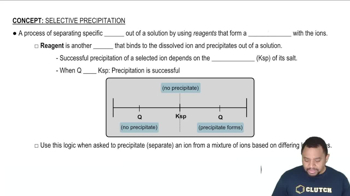
What happens when the reaction quotient (Q) is greater than Ksp?
When Q > Ksp, precipitation occurs as the system shifts to restore equilibrium, forming a solid.
What is the result if Q is less than Ksp in a solution?
If Q < Ksp, the reaction shifts forward, producing more ions and no precipitate forms.
What does it mean when Q equals Ksp?
When Q = Ksp, the system is at equilibrium and no precipitate forms.
Why does precipitation occur only when Q exceeds Ksp?
Precipitation occurs because the system shifts in the reverse direction to restore equilibrium, forming a solid.
How can selective precipitation separate specific ions from a mixture?
By choosing reagents that will precipitate the target ion first, based on differing Ksp values.
What is the general process for selective precipitation?
It involves adding a reagent to a mixture of ions to form a precipitate with the ion that has the lowest Ksp.
What happens to the chemical reaction when Q < Ksp?
The reaction shifts forward, making more ions and moving away from solid, so no precipitate forms.
What is the significance of Ksp in selective precipitation?
Ksp determines the solubility of a salt and which ion will precipitate first when reagents are added.
How do you decide which ion will precipitate first in a mixture?
The ion whose salt has the lowest Ksp will precipitate first when the appropriate reagent is added.
What is the effect of adding a reagent to a mixture of ions?
The reagent binds to certain ions, forming a precipitate and separating those ions from the solution.
What direction does the reaction shift when Q > Ksp?
The reaction shifts in the reverse direction, toward forming a solid (precipitate).
Why is understanding Ksp important for selective precipitation?
Understanding Ksp is crucial for choosing the right reagent and successfully separating ionic compounds by precipitation.
 뒤로
뒤로
 01:53
01:53