Skip to main content
General Chemistry
나의 코스
배우기
시험 준비
AI 튜터
학습 가이드
교과서적 해결책
플래시카드
탐험해 보세요
앱을 사용해 보세요
나의 코스
배우기
시험 준비
AI 튜터
학습 가이드
교과서적 해결책
플래시카드
탐험해 보세요
앱을 사용해 보세요
뒤로
The Ideal Gas Law quiz #1
카드를 뒤집기 위해 탭할 수 있습니다.
Which law forms the basis of the ideal gas law?
카드를 뒤집기 위해 탭할 수 있습니다.
👆
Which law forms the basis of the ideal gas law?
The ideal gas law combines Boyle's, Charles's, and Avogadro's laws.
진행 상황 추적
컨트롤 버튼이 '내비게이션' 모드로 변경되었습니다.
1/39
관련 플래시카드
관련 실천
추천 영상
The Ideal Gas Law definitions
The Ideal Gas Law
11 용어
The Ideal Gas Law quiz
The Ideal Gas Law
18 용어
The Ideal Gas Law quiz #2
The Ideal Gas Law
40 용어
The Ideal Gas Law
7. Gases
7 문제점
주제
Jules
The Ideal Gas Law Derivations
7. Gases
7 문제점
주제
Jules
7. Gases - Part 1 of 4
5 주제
14 문제점
장
Jules
7. Gases - Part 2 of 4
5 주제
13 문제점
장
Jules
7. Gases - Part 3 of 4
5 주제
13 문제점
장
Jules
7. Gases - Part 4 of 4
5 주제
13 문제점
장
Jules
VideoThumbView.guidedCourse
02:58
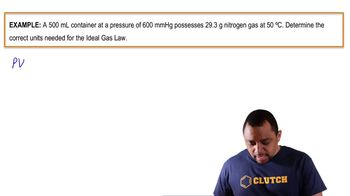
Ideal Gas Law Units Example
9897
views
84
rank
6
comments
VideoThumbView.guidedCourse
01:15
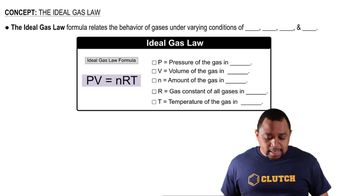
Ideal Gas Law Formula
10807
views
96
rank
2
comments
VideoThumbView.guidedCourse
01:56
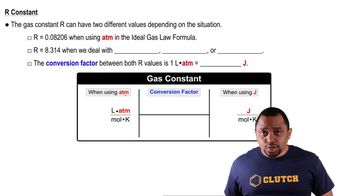
Gas Constant Values
8774
views
49
rank
이 집합의 용어 (39)
하이드의 정의
Which law forms the basis of the ideal gas law?
The ideal gas law combines Boyle's, Charles's, and Avogadro's laws.
Which of these changes most likely results in an increase in the volume of a gas?
Increasing temperature or decreasing pressure increases the volume of a gas.
Under which conditions does the molar volume of a gas decrease?
Molar volume decreases when pressure increases or temperature decreases.
Which correctly defines the molar volume of an ideal gas?
Molar volume is the volume occupied by one mole of an ideal gas at a given temperature and pressure.
Under what conditions are gases most likely to behave ideally?
Gases behave most ideally at high temperature and low pressure.
Which gases does the ideal gas law best describe at 0°C and 1 atm?
The ideal gas law best describes light, nonpolar gases like helium or nitrogen at 0°C and 1 atm.
What is the relationship between pressure and temperature for a gas?
Pressure is directly proportional to temperature for a fixed volume and amount of gas.
How many moles of gas are in a 20 L container with a pressure of 2 atm at a temperature of 400 K?
n = PV/RT = (2 × 20) / (0.08206 × 400) ≈ 1.22 moles.
What is the mass (g) of oxygen in our lungs if we inhale 1.5 liters of O2 at STP?
At STP, 1 mole occupies 22.4 L. Moles = 1.5/22.4 ≈ 0.067 mol. Mass = 0.067 × 32 g/mol ≈ 2.14 g.
Which molecule exhibits the most ideal gas behavior?
Helium (He) would exhibit the most ideal behavior.
Which are properties of ideal gases?
Ideal gases have negligible volume, no intermolecular forces, and perfectly elastic collisions.
Why does the pressure inside a container of gas increase if more gas is added to the container?
Adding more gas increases the number of particles, leading to more collisions and higher pressure.
What kind of gas is inside a neon sign?
Neon signs contain neon gas.
Does gas have mass?
Yes, gases have mass.
What is the correct expression for Avogadro's law where k is a constant?
V/n = k, where V is volume and n is moles.
Does the property of negligible intermolecular forces apply to an ideal gas?
Yes, ideal gases are assumed to have negligible intermolecular forces.
Why does an open soda go flat?
An open soda goes flat because dissolved CO2 gas escapes, reducing pressure and carbonation.
To which quantity is the density of an ideal gas directly proportional?
Density is directly proportional to pressure.
Under which conditions of temperature and pressure would a gas behave most like an ideal gas?
High temperature and low pressure.
What relationships between pressure, temperature, moles, and volume are consistent with the ideal gas law?
Pressure is directly proportional to temperature and moles, and inversely proportional to volume.
Which laws can be combined to form the ideal gas law?
Boyle's, Charles's, and Avogadro's laws.
Why is it important to convert temperature into units of Kelvin before using the ideal gas law?
Kelvin is an absolute scale; negative temperatures are not possible in gas law calculations.
What is true about the relationship between pressure and volume of a gas?
Pressure and volume are inversely related (Boyle's law).
How does the pressure of gas in a closed container compare to the volume of the container?
Pressure is inversely proportional to volume for a fixed amount and temperature.
Do gases have mass?
Yes, gases have mass.
Which is a common unit for the ideal gas constant R?
0.08206 L·atm/(mol·K)
Which variable is not included in the ideal gas equation?
Density is not directly included in the ideal gas equation.
When must temperature values in gas law calculations be expressed in Kelvin units?
Always; temperature must be in Kelvin for gas law calculations.
Which gases deviate most from ideal behavior?
Gases with strong intermolecular forces, like water vapor (H2O), deviate most.
Under what condition does the volume of the ideal gas approach zero?
At extremely low temperatures or extremely high pressures.
What are the characteristics of ideal gases regarding intermolecular forces and volume?
Ideal gases have no intermolecular forces and occupy negligible volume.
Which statement best describes Boyle’s law?
Boyle’s law states that pressure and volume are inversely related for a fixed amount of gas at constant temperature.
A balloon is inflated to 7.0 L of volume at STP. How many moles of gas does it contain?
Moles = 7.0 L / 22.4 L/mol ≈ 0.313 mol.
Which law can be used to calculate the number of moles of a contained gas?
The ideal gas law (PV = nRT).
Which of these is not a variable in the ideal gas law?
Mass is not a variable in the ideal gas law.
Which gas deviates the least from ideal gas behavior?
Helium (He) would deviate the least.
What is the formula for Boyle's law?
P1V1 = P2V2
Which sequence describes the result of increasing the number of gas particles in a container?
Increasing particles increases pressure if volume and temperature are constant.
How does the pressure change if you heat a gas enclosed in a rigid container?
Pressure increases as temperature increases.
 뒤로뒤로
뒤로뒤로
 02:58
02:58