Skip to main content
General Chemistry
나의 코스
배우기
시험 준비
AI 튜터
학습 가이드
교과서적 해결책
플래시카드
탐험해 보세요
앱을 사용해 보세요
나의 코스
배우기
시험 준비
AI 튜터
학습 가이드
교과서적 해결책
플래시카드
탐험해 보세요
앱을 사용해 보세요
뒤로
Thermal Equilibrium quiz
카드를 뒤집기 위해 탭할 수 있습니다.
What is thermal equilibrium?
카드를 뒤집기 위해 탭할 수 있습니다.
👆
What is thermal equilibrium?
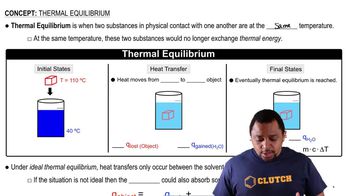
Thermal equilibrium is when two substances in physical contact reach the same temperature and stop exchanging thermal energy.
진행 상황 추적
컨트롤 버튼이 '내비게이션' 모드로 변경되었습니다.
1/15
관련 플래시카드
관련 실천
추천 영상
Thermal Equilibrium definitions
Thermal Equilibrium
12 용어
Thermal Equilibrium quiz #1
Thermal Equilibrium
13 용어
Thermal Equilibrium
8. Thermochemistry
6 문제점
주제
Jules
Thermochemical Equations
8. Thermochemistry
6 문제점
주제
Jules
8. Thermochemistry - Part 1 of 3
5 주제
13 문제점
장
Jules
8. Thermochemistry - Part 2 of 3
5 주제
13 문제점
장
Jules
8. Thermochemistry - Part 3 of 3
5 주제
13 문제점
장
Jules
VideoThumbView.guidedCourse
02:35
Thermal Equilibrium
4695
views
27
rank
VideoThumbView.guidedCourse
2:14
Thermal Equilibrium Example 1
6648
views
32
rank
1
comments
이 집합의 용어 (15)
하이드의 정의
What is thermal equilibrium?
Thermal equilibrium is when two substances in physical contact reach the same temperature and stop exchanging thermal energy.
What happens to heat transfer when thermal equilibrium is reached?
Heat transfer ceases because both substances are at the same temperature.
In the example of a heated metal cube placed in water, which object loses heat?
The heated metal cube loses heat, indicated by a negative Q.
What is the sign of Q for the object absorbing heat?
The object absorbing heat has a positive Q.
What equation represents the heat lost and gained at thermal equilibrium?
The equation is negative Q (hotter object) equals positive Q (colder object).
What is the formula for calculating heat (Q)?
Q = m c ΔT, where m is mass, c is specific heat capacity, and ΔT is the change in temperature.
How does heat transfer direction relate to temperature difference?
Heat always moves from the hotter object to the colder object.
What happens to the temperature of both objects at thermal equilibrium?
Both objects reach the same temperature.
What must be considered in non-ideal thermal equilibrium situations?
The calorimeter or container may absorb some heat, so its heat must be included in calculations.
How does the heat equation change when the calorimeter absorbs heat?
The equation becomes negative Q (object) = positive Q (water) + Q (calorimeter).
What is the role of the calorimeter in thermal equilibrium experiments?
The calorimeter absorbs some heat, affecting the total heat exchange.
What does the first law of thermodynamics state about energy exchange at equilibrium?
At equilibrium, energy exchange stops because both substances have equal temperatures.
What is the significance of the negative and positive signs in Q?
Negative Q indicates heat loss, while positive Q indicates heat gain.
When can you ignore the heat absorbed by the container in calculations?
You can ignore it in ideal thermal equilibrium situations where only the solvent and object exchange heat.
Why is understanding thermal equilibrium important in physical systems?
It helps explain energy transfer and the approach to thermal balance in physical systems.
 뒤로뒤로
뒤로뒤로
 02:35
02:35