Skip to main content
General Chemistry
나의 코스
배우기
시험 준비
AI 튜터
학습 가이드
교과서적 해결책
플래시카드
탐험해 보세요
앱을 사용해 보세요
나의 코스
배우기
시험 준비
AI 튜터
학습 가이드
교과서적 해결책
플래시카드
탐험해 보세요
앱을 사용해 보세요
뒤로
Thermochemical Equations quiz
카드를 뒤집기 위해 탭할 수 있습니다.
What does a thermochemical equation include that a regular balanced chemical equation does not?
카드를 뒤집기 위해 탭할 수 있습니다.
👆
What does a thermochemical equation include that a regular balanced chemical equation does not?
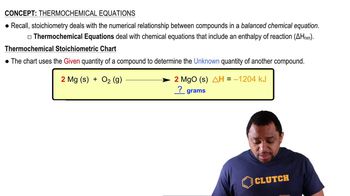
A thermochemical equation includes the enthalpy change of reaction (ΔHrxn) alongside the balanced chemical equation.
진행 상황 추적
컨트롤 버튼이 '내비게이션' 모드로 변경되었습니다.
1/15
관련 플래시카드
관련 실천
추천 영상
Thermochemical Equations definitions
Thermochemical Equations
15 용어
Thermochemical Equations quiz #1
Thermochemical Equations
14 용어
Thermochemical Equations
8. Thermochemistry
6 문제점
주제
Jules
Formation Equations
8. Thermochemistry
4 문제점
주제
Jules
8. Thermochemistry - Part 1 of 3
5 주제
13 문제점
장
Jules
8. Thermochemistry - Part 2 of 3
5 주제
13 문제점
장
Jules
8. Thermochemistry - Part 3 of 3
5 주제
13 문제점
장
Jules
VideoThumbView.guidedCourse
01:13
Thermochemical Equations
8136
views
36
rank
VideoThumbView.guidedCourse
01:57
Thermochemical Equations
6720
views
27
rank
VideoThumbView.guidedCourse
02:24
Thermochemical Equations Example 1
7174
views
45
rank
1
comments
이 집합의 용어 (15)
하이드의 정의
What does a thermochemical equation include that a regular balanced chemical equation does not?
A thermochemical equation includes the enthalpy change of reaction (ΔHrxn) alongside the balanced chemical equation.
What does ΔHrxn represent in a thermochemical equation?
ΔHrxn represents the enthalpy change, or the heat absorbed or released, during a chemical reaction.
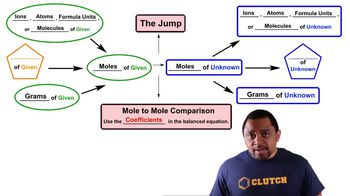
What is the main purpose of a thermochemical stoichiometric chart?
It helps convert between different quantities (like moles, grams, or molecules) and the associated enthalpy change in a reaction.
In thermochemical equations, what key comparison is made instead of just mole-to-mole?
A delta H to mole comparison is made, relating enthalpy change to the amount of substance.
How do you use the coefficients in a balanced thermochemical equation?
The coefficients are used to perform mole-to-mole comparisons between reactants and products.
What is the 'jump' in a thermochemical stoichiometric chart?
The 'jump' refers to moving from moles of a known substance to moles of an unknown substance using the balanced equation.
Why is it important to relate ΔHrxn to the moles of a compound in a reaction?
Relating ΔHrxn to moles allows you to calculate the enthalpy change for any amount of reactant or product.
What types of quantities can be converted using a thermochemical stoichiometric chart?
Quantities like moles, grams, molecules, ions, atoms, or formula units can be converted.
What must be present for a chemical equation to be considered thermochemical?
The equation must include both a balanced chemical equation and the ΔHrxn value.
How can you determine the enthalpy change for an unknown component in a reaction?
By using the coefficients from the balanced equation to relate moles of known and unknown substances to ΔHrxn.
What is the relationship between stoichiometry and thermochemical equations?
Thermochemical equations combine stoichiometry with thermodynamics by including energy changes in mole relationships.
What is the first step when using a thermochemical stoichiometric chart?
The first step is to identify the given quantity, such as ΔH or moles, for a compound in the reaction.
After finding moles of the unknown, what can you convert to next in a thermochemical equation?
You can convert to grams, molecules, ions, or a new ΔH for the unknown.
Why is understanding thermochemical equations important?
It is essential for predicting the energy changes that accompany chemical processes.
What is the key difference between regular stoichiometry and thermochemical equations?
Thermochemical equations focus on the relationship between enthalpy change and the amount of substance, not just mole ratios.
 뒤로
뒤로
 01:13
01:13