Skip to main content
General Chemistry
나의 코스
배우기
시험 준비
AI 튜터
학습 가이드
교과서적 해결책
플래시카드
탐험해 보세요
앱을 사용해 보세요
나의 코스
배우기
시험 준비
AI 튜터
학습 가이드
교과서적 해결책
플래시카드
탐험해 보세요
앱을 사용해 보세요
뒤로
Using Hess's Law To Determine K quiz
카드를 뒤집기 위해 탭할 수 있습니다.
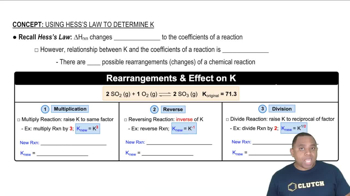
What happens to the equilibrium constant K if you multiply all the coefficients in a chemical reaction by 3?
카드를 뒤집기 위해 탭할 수 있습니다.
👆
What happens to the equilibrium constant K if you multiply all the coefficients in a chemical reaction by 3?
K is raised to the third power (K^3), so the new K becomes the original K cubed.
진행 상황 추적
컨트롤 버튼이 '내비게이션' 모드로 변경되었습니다.
1/15
관련 플래시카드
관련 실천
추천 영상
Using Hess's Law To Determine K definitions
Using Hess's Law To Determine K
15 용어
Using Hess's Law To Determine K
16. Chemical Equilibrium
3 문제점
주제
ErnestBlazevic
Calculating K for Overall Reaction
16. Chemical Equilibrium
5 문제점
주제
Jules
16. Chemical Equilibrium - Part 1 of 2
5 주제
13 문제점
장
Jules
16. Chemical Equilibrium - Part 2 of 2
5 주제
13 문제점
장
Jules
VideoThumbView.guidedCourse
04:22
Hess's Law and Equilibrium Constant
4301
views
41
rank
2
comments
VideoThumbView.guidedCourse
03:34
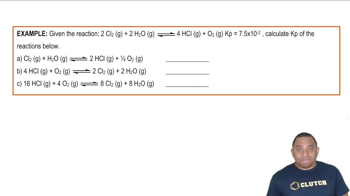
Hess's Law and Kp Example
3175
views
33
rank
이 집합의 용어 (15)
하이드의 정의
What happens to the equilibrium constant K if you multiply all the coefficients in a chemical reaction by 3?
K is raised to the third power (K^3), so the new K becomes the original K cubed.
How does reversing a chemical reaction affect the equilibrium constant K?
Reversing the reaction takes the inverse of K, so the new K is 1 divided by the original K.
If you divide all the coefficients in a reaction by 2, what happens to K?
K is raised to the one-half power (K^0.5), which is the square root of the original K.
Is the relationship between K and the coefficients of a reaction linear or exponential?
The relationship is exponential, not linear.
What is the new K value if the original K is 71.3 and the reaction is multiplied by 3?
The new K is 71.3 cubed, which equals 362,467.097.
What is the new K value if the original K is 71.3 and the reaction is reversed?
The new K is 1/71.3, which equals 0.0140.
What is the new K value if the original K is 71.3 and the reaction is divided by 2?
The new K is the square root of 71.3, which is 8.44.
What does multiplying a reaction by a factor n do to the equilibrium constant K?
It raises K to the nth power (K^n).
What does dividing a reaction by a factor n do to the equilibrium constant K?
It raises K to the 1/n power (K^(1/n)).
What does it mean to reverse a chemical reaction in terms of reactants and products?
Reversing a reaction swaps the reactants and products.
If a reaction is divided by 3, how is K affected?
K is raised to the one-third power (K^(1/3)).
If a reaction is multiplied by 4, what happens to K?
K is raised to the fourth power (K^4).
Why is it important to understand how changes to a reaction affect K?
Because these changes can significantly impact the equilibrium constant and the system's behavior.
What is the effect on K if you reverse and then multiply a reaction by 2?
K becomes the inverse raised to the second power, or (1/K)^2.
How does the effect of changing coefficients on K differ from its effect on ΔH (enthalpy)?
ΔH changes proportionally with coefficients, while K changes exponentially.
 뒤로뒤로
뒤로뒤로

 04:22
04:22