 뒤로
뒤로ch-3
 02:53
02:53
이 집합의 용어 (20)
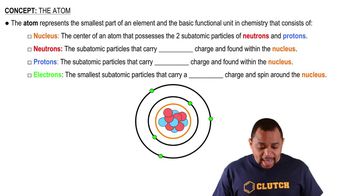
The three main subatomic particles are protons, neutrons, and electrons.
A proton has a positive charge (+1) and a relative mass of approximately 1 atomic mass unit (amu).
A neutron has no charge (neutral) and a relative mass of approximately 1 amu.
An electron has a negative charge (-1) and a relative mass of about 1/1836 amu, which is negligible compared to protons and neutrons.
The atomic number is the number of protons in an atom's nucleus and defines the element.
The mass number is the total number of protons and neutrons in an atom's nucleus.
Isotopes are atoms of the same element with the same number of protons but different numbers of neutrons.
Electron configuration describes the arrangement of electrons in an atom's shells or energy levels.
Atomic shells are energy levels around the nucleus where electrons are likely to be found.
Ernest Rutherford proposed the early atomic model with a dense, positively charged nucleus.
The atomic number determines the element's identity and its position on the periodic table.
Isotopes have different masses, which can affect physical properties like density and stability.
Because an electron's mass is about 1/1836 that of a proton, it has little effect on the atom's total mass.
Neutrons add mass and help stabilize the nucleus by reducing proton-proton repulsion.
Electron configuration determines how atoms interact and bond, influencing chemical behavior.
The nucleus has a positive charge equal to the number of protons it contains.
It showed that atoms have a small, dense, positively charged nucleus with electrons orbiting around it.
Electrons fill shells starting from the lowest energy level outward, following specific capacity rules.
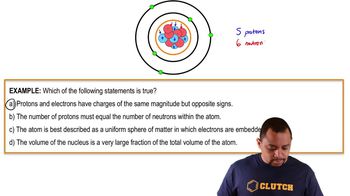
In a neutral atom, the number of electrons equals the atomic number (number of protons).
Isotopes are used in dating, tracing chemical pathways, and medical diagnostics due to their unique nuclear properties.