Skip to main content
General Chemistry
나의 코스
배우기
시험 준비
AI 튜터
학습 가이드
교과서적 해결책
플래시카드
탐험해 보세요
앱을 사용해 보세요
나의 코스
배우기
시험 준비
AI 튜터
학습 가이드
교과서적 해결책
플래시카드
탐험해 보세요
앱을 사용해 보세요
뒤로
ch-4
카드를 뒤집기 위해 탭할 수 있습니다.
How is the periodic table organized?
카드를 뒤집기 위해 탭할 수 있습니다.
👆
How is the periodic table organized?
By increasing
atomic number
, arranged in
groups
(columns) and
periods
(rows).
진행 상황 추적
컨트롤 버튼이 '내비게이션' 모드로 변경되었습니다.
1/20
추천 영상
VideoThumbView.guidedCourse
01:12
Nonmetal Properties
10236
views
92
rank
VideoThumbView.guidedCourse
02:40
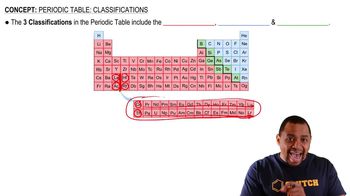
Periodic Table Classifications
13584
views
180
rank
1
comments
VideoThumbView.guidedCourse
03:37
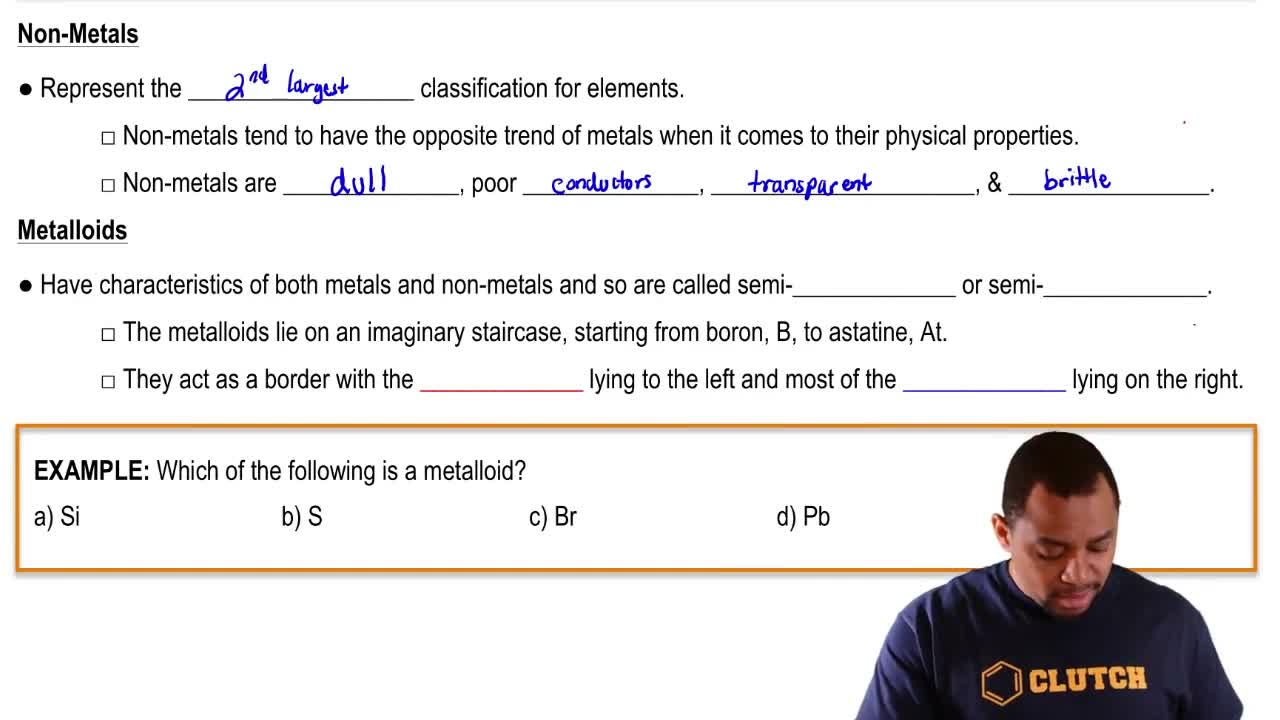
Metalloid Properties
9353
views
149
rank
이 집합의 용어 (20)
하이드의 정의
How is the periodic table organized?
By increasing
atomic number
, arranged in
groups
(columns) and
periods
(rows).
What defines a group in the periodic table?
A
vertical column
of elements with similar chemical properties and the same number of valence electrons.
What defines a period in the periodic table?
A
horizontal row
of elements where properties change progressively across the row.
What is the trend in reactivity for alkali metals down the group?
Reactivity
increases
down the group due to easier loss of the outer electron.
What is the general trend in metallic character across a period?
Metallic character
decreases
from left to right across a period.
What are the key properties of alkali metals?
Highly reactive, soft metals with one valence electron, found in group 1.
What are halogens and their general properties?
Group 17 elements, highly reactive nonmetals, typically form salts with metals.
What characterizes noble gases?
Group 18 elements, inert gases with full valence shells, very low reactivity.
What are transition metals?
Elements in groups 3-12, characterized by d-electrons, variable oxidation states, and often colored compounds.
How does atomic number relate to element properties?
Atomic number determines the number of protons and electrons, influencing chemical behavior.
What is the trend in atomic radius across a period?
Atomic radius
decreases
from left to right due to increasing nuclear charge pulling electrons closer.
What is the trend in atomic radius down a group?
Atomic radius
increases
down a group because of added electron shells.
How does electronegativity change across a period?
Electronegativity
increases
from left to right across a period.
How does electronegativity change down a group?
Electronegativity
decreases
down a group.
What is metallic character?
The tendency of an element to lose electrons and form positive ions; higher in metals.
Why are noble gases inert?
They have
full valence electron shells
, making them stable and unreactive.
What is the significance of groups in predicting element behavior?
Elements in the same group have similar valence electron configurations, leading to similar chemical properties.
What is the general trend in ionization energy across a period?
Ionization energy
increases
from left to right due to stronger nuclear attraction.
What is the general trend in ionization energy down a group?
Ionization energy
decreases
down a group because outer electrons are farther from the nucleus.
How do transition metals differ from main group elements?
Transition metals have partially filled d orbitals, variable oxidation states, and often form colored ions.
 뒤로뒤로
뒤로뒤로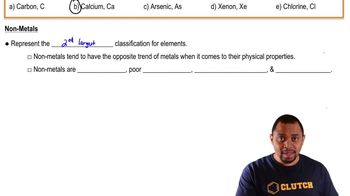
 01:12
01:12