Skip to main content
General Chemistry
나의 코스
배우기
시험 준비
AI 튜터
학습 가이드
교과서적 해결책
플래시카드
탐험해 보세요
앱을 사용해 보세요
나의 코스
배우기
시험 준비
AI 튜터
학습 가이드
교과서적 해결책
플래시카드
탐험해 보세요
앱을 사용해 보세요
뒤로
CHM 211; CH.4: Solutions, Reactions, and Redox
카드를 뒤집기 위해 탭할 수 있습니다.
What is a solution composed of?
카드를 뒤집기 위해 탭할 수 있습니다.
👆
What is a solution composed of?
A solution is composed of a
solvent
that solvates a
solute
. For example, water is a solvent in aqueous solutions.
진행 상황 추적
컨트롤 버튼이 '내비게이션' 모드로 변경되었습니다.
1/26
추천 영상
VideoThumbView.guidedCourse
01:16
Identify Mixtures Example
9728
views
218
rank
4
comments
VideoThumbView.guidedCourse
02:38
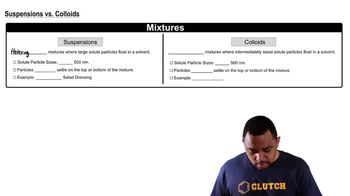
Suspensions and Colloids
11483
views
109
rank
2
comments
VideoThumbView.guidedCourse
1:17
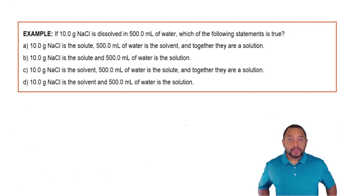
Solution Components Example
11836
views
163
rank
3
comments
이 집합의 용어 (26)
하이드의 정의
What is a solution composed of?
A solution is composed of a
solvent
that solvates a
solute
. For example, water is a solvent in aqueous solutions.
What happens to ionic compounds in aqueous solutions?
Ionic compounds dissociate into individual ions in aqueous solutions due to water's high polarity.
Define molarity (M).
Molarity is the concentration of a solution expressed as moles of solute per liter of solution: \(M=\frac{mol}{L}\).
How do you calculate moles of ions from moles of ionic compound?
Use the dissociation equation to multiply moles of compound by the number of ions produced per formula unit.
What is the dilution equation?
Dilution is calculated using \(M_iV_i=M_fV_f\), where initial and final molarity and volume are related.
What is a double displacement (salt metathesis) reaction?
A reaction where ions exchange between two ionic compounds, often forming a precipitate.
What is a total ionic equation?
An equation showing all soluble ionic substances dissociated into ions.
What are spectator ions?
Ions that do not participate in the chemical change and appear unchanged on both sides of the ionic equation.
What is a net ionic equation?
An equation showing only the ions and compounds directly involved in the chemical reaction, excluding spectator ions.
What do solubility rules predict?
They predict whether an ionic compound is soluble or will form a precipitate in water.
Name three generally soluble ionic compounds.
Group 1 salts, ammonium salts (NH4+), and nitrates (NO3−) are generally soluble.
What is a neutralization reaction?
A double displacement reaction between an acid and a base forming water and an ionic salt.
What defines a strong acid or base?
Strong acids and bases completely dissociate into ions in aqueous solution, acting as strong electrolytes.
List six common strong acids.
HCl, HBr, HI, HNO3, H2SO4 (first H only), and HClO4.
What are strong bases commonly composed of?
Group 1 hydroxides (e.g., NaOH) and heavy Group 2 hydroxides (e.g., Ca(OH)2).
What is the difference between oxidation and reduction?
Oxidation is loss of electrons; reduction is gain of electrons.
What is an oxidizing agent?
A substance that causes oxidation by accepting electrons and is itself reduced.
What is a reducing agent?
A substance that causes reduction by donating electrons and is itself oxidized.
What are oxidation numbers (O.N.)?
Numerical values assigned to atoms to indicate electron loss or gain in compounds.
What is the oxidation number of oxygen in most compounds?
Usually −2, except in peroxides or when bonded to fluorine.
What is the oxidation number of hydrogen?
+1 when bonded to nonmetals, −1 when bonded to metals or metalloids.
What is a combination reaction?
Two or more reactants combine to form one product.
What is a decomposition reaction?
One reactant breaks down into two or more products.
What is a combustion reaction?
An organic compound reacts with O2 producing CO2 and H2O, releasing energy.
What is a single displacement reaction?
An element displaces another element from a compound, forming a new compound and elemental substance.
How do you classify redox reactions?
As combination, decomposition, or displacement based on reactants and products.
 뒤로뒤로
뒤로뒤로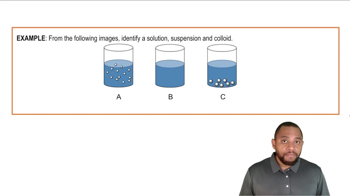
 01:16
01:16