Skip to main content
General Chemistry
나의 코스
배우기
시험 준비
AI 튜터
학습 가이드
교과서적 해결책
플래시카드
탐험해 보세요
앱을 사용해 보세요
나의 코스
배우기
시험 준비
AI 튜터
학습 가이드
교과서적 해결책
플래시카드
탐험해 보세요
앱을 사용해 보세요
뒤로
CHM 211; CH.5: Gas Laws and Molecular Nature of Matter
카드를 뒤집기 위해 탭할 수 있습니다.
What is atmospheric pressure at sea level in common units?
카드를 뒤집기 위해 탭할 수 있습니다.
👆
What is atmospheric pressure at sea level in common units?
1 atm
= 760 mmHg = 101.325 kPa
진행 상황 추적
컨트롤 버튼이 '내비게이션' 모드로 변경되었습니다.
1/20
추천 영상
VideoThumbView.guidedCourse
02:20
STP Calculation Example
6242
views
25
rank
1
comments
VideoThumbView.guidedCourse
01:08
Standard Temperature and Pressure
7479
views
31
rank
2
comments
VideoThumbView.guidedCourse
01:44
Moles of Gas Example
6319
views
23
rank
1
comments
이 집합의 용어 (20)
하이드의 정의
What is atmospheric pressure at sea level in common units?
1 atm
= 760 mmHg = 101.325 kPa
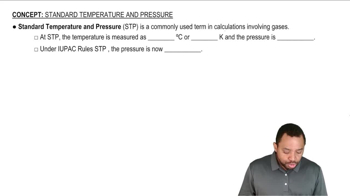
What are the standard temperature and pressure (STP) conditions?
1 atm
pressure and
0 °C (273 K)
temperature
How do gases differ from liquids and solids in terms of volume change?
Gas volume changes significantly with pressure and temperature, unlike solids and liquids.
State Boyle's Law and its formula.
At constant temperature, volume is inversely proportional to pressure: \(PV=\text{constant}\) or \(P_1V_1=P_2V_2\)
State Charles's Law and its formula.
At constant pressure, volume is directly proportional to absolute temperature: \(\frac{V}{T}=\text{constant}\) or \(\frac{V_1}{T_1}=\frac{V_2}{T_2}\)
State Avogadro's Law and its formula.
At constant temperature and pressure, volume is directly proportional to moles: \(\frac{V}{n}=\text{constant}\) or \(\frac{V_1}{n_1}=\frac{V_2}{n_2}\)
What is the Ideal Gas Law formula?
\(PV=nRT\), relating pressure, volume, moles, and temperature.
What are the ideal gas assumptions?
No intermolecular forces, gas molecules have negligible volume, and collisions are elastic with no kinetic energy loss.
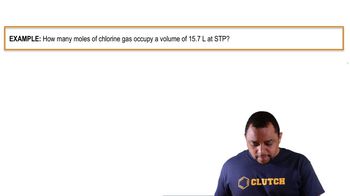
What volume does 1 mole of an ideal gas occupy at STP?
22.4 L
at 0 °C and 1 atm
How do you calculate the density of a gas using the ideal gas law?
\(d=\frac{MP}{RT}\), where M is molar mass.
What is Dalton's Law of Partial Pressures?
Total pressure is the sum of partial pressures: \(P_T=P_A+P_B+\cdots\) and \(P_A=X_AP_T\) where
X_A
is mole fraction.
What does the kinetic molecular theory state about gas molecules?
Gas molecules are in constant, random motion with a distribution of speeds related to temperature.
How is the average kinetic energy of gas molecules related to temperature?
\(KE=\frac{3}{2}k_BT\), where
k_B
is Boltzmann's constant.
What is the formula for root-mean-square speed of gas molecules?
\(u_{rms}=\sqrt{\frac{3RT}{M}}\), where M is molar mass in kg/mol.
State Graham's Law of Effusion and Diffusion.
Rate ratio relates inversely to square root of molar masses: \(\frac{r_1}{r_2}=\sqrt{\frac{M_2}{M_1}}\)
Why do real gases deviate from ideal gas behavior?
Real gases have finite volume and experience intermolecular forces, especially at low temperature and high pressure.
What is the Van der Waals equation for real gases?
\(\left(P+\frac{n^2a}{V^2}\right)(V-nb)=nRT\), where
a
and
b
correct for attractions and volume.
How does gas volume change with temperature at constant pressure?
Gas volume increases as temperature increases, according to Charles's Law.
How does gas pressure change with volume at constant temperature?
Gas pressure increases as volume decreases, according to Boyle's Law.
How do you calculate molar mass from the ideal gas law?
\(M=\frac{mRT}{PV}\), where m is mass of gas.
 뒤로뒤로
뒤로뒤로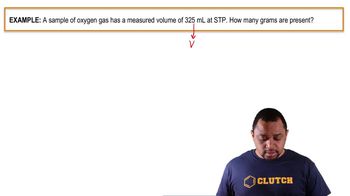
 02:20
02:20