Skip to main content
General Chemistry
나의 코스
배우기
시험 준비
AI 튜터
학습 가이드
교과서적 해결책
플래시카드
탐험해 보세요
앱을 사용해 보세요
나의 코스
배우기
시험 준비
AI 튜터
학습 가이드
교과서적 해결책
플래시카드
탐험해 보세요
앱을 사용해 보세요
뒤로
General Chemistry: Atoms, Molecules, Ions & Nomenclature
카드를 뒤집기 위해 탭할 수 있습니다.
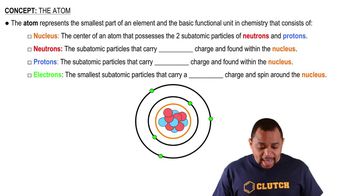
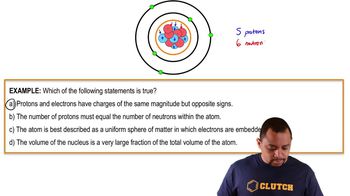
What are the three main subatomic particles in an atom?
카드를 뒤집기 위해 탭할 수 있습니다.
👆
What are the three main subatomic particles in an atom?
Protons
(positive charge),
neutrons
(neutral), and
electrons
(negative charge).
진행 상황 추적
컨트롤 버튼이 '내비게이션' 모드로 변경되었습니다.
1/20
추천 영상
VideoThumbView.guidedCourse
02:53
The Nucleus
11127
views
150
rank
1
comments
VideoThumbView.guidedCourse
02:10
Atom Structure
10640
views
199
rank
1
comments
VideoThumbView.guidedCourse
02:52
Atom Structure Example
11874
views
149
rank
이 집합의 용어 (20)
하이드의 정의
What are the three main subatomic particles in an atom?
Protons
(positive charge),
neutrons
(neutral), and
electrons
(negative charge).
Where are protons and neutrons located in an atom?
They are located in the
nucleus
, which is very small compared to the atom's size.
What is the atomic number (Z) of an element?
The number of
protons
in the nucleus of an atom.
Define mass number (A).
The total number of
protons and neutrons
(nucleons) in the nucleus.
What are isotopes?
Atoms of the same element with the same number of protons but different numbers of neutrons.
How is atomic mass unit (amu) defined?
1 amu = 1.66054 × 10
-24
g, a unit used to express atomic and molecular masses.
What is atomic weight (relative atomic mass)?
The weighted average mass of an element's isotopes based on their natural abundance.
How does a mass spectrometer help in chemistry?
It measures accurate atomic and molecular weights and determines isotope abundances.
How are elements arranged in the periodic table?
Elements are arranged in order of increasing
atomic number
.
What do elements in the same group of the periodic table have in common?
They have similar
chemical properties
.
What is the difference between molecular and empirical formulas?
Molecular formulas show the exact number of atoms; empirical formulas show the lowest whole-number ratio.
What is a cation and how is it formed?
A
cation
is a positively charged ion formed by losing one or more electrons, usually from metals.
What is an anion and how is it formed?
An
anion
is a negatively charged ion formed by gaining one or more electrons, usually from nonmetals.
What are polyatomic ions?
Ions composed of a group of atoms that gain or lose electrons together, e.g., ammonium (NH4
+
) and sulfate (SO4
2-
).
How are ionic compounds formed?
By transfer of electrons from metals to nonmetals, forming cations and anions that attract each other.
How do you write the formula of an ionic compound?
Use the charge of the cation as the subscript of the anion and vice versa, then reduce to the lowest ratio.
How do you name ionic compounds with variable cation charges?
Write the cation name followed by its charge in Roman numerals in parentheses, then the anion name.
What suffixes are used for oxyanions with fewer and more oxygens?
The one with fewer oxygens ends in
-ite
, and the one with more oxygens ends in
-ate
.
How are acids named based on their anions?
Anions ending in
-ite
form acids ending in
-ous acid
; those ending in
-ate
form acids ending in
-ic acid
.
What is the naming rule for binary molecular compounds?
Name the element farther left or lower in the group first, use prefixes for atom counts, and end the second element with
-ide
.
 뒤로뒤로
뒤로뒤로
 02:53
02:53