 뒤로
뒤로General Chemistry: Chemical Reactions and Stoichiometry
 5:39
5:39
이 집합의 용어 (20)
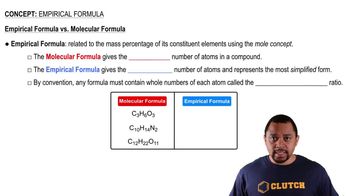
The simplest whole-number ratio of atoms in a compound, derived from mass percentages using moles.
Gives the actual number of atoms of each element in a compound, which is a multiple of the empirical formula.
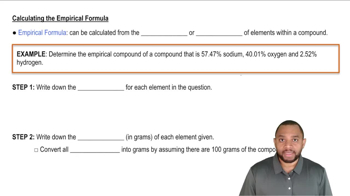
- Write down mass or % of each element.
- Convert masses to grams (assume 100 g if % given).
- Convert grams to moles.
- Divide moles by smallest mole value.
- Adjust to whole numbers by rounding or multiplying.
- Find empirical formula.
- Calculate empirical formula mass.
- Divide molar mass by empirical mass to find n-factor.
- Multiply empirical formula subscripts by n-factor.
Used to determine the empirical formula of compounds by burning them and analyzing the products CO2 and H2O.
- Convert CO2 mass to C mass.
- Convert H2O mass to H mass.
- Subtract C and H masses from total to find O mass if present.
- Convert all masses to moles.
- Divide by smallest mole value and adjust to whole numbers.
Includes elements like N, S, halogens; products may include gases like NO, SO2, or halogen gases.
Ensure the number of atoms of each element is equal on both sides using stoichiometric coefficients. Multiply to clear fractions.
Quantitative relationship between reactants and products in a balanced chemical equation, used to calculate amounts of substances.
The reactant that is completely consumed first, limiting the amount of product formed.
The reactant that remains after the limiting reagent is used up.
The maximum amount of product predicted from stoichiometric calculations assuming complete reaction.
The amount of product actually obtained from an experiment, usually less than theoretical yield.
\(\text{Percent Yield} = \frac{\text{Actual Yield}}{\text{Theoretical Yield}} \times 100\%\)
Percentage by mass of an element in a compound calculated as \(\frac{\text{mass of element}}{\text{mass of compound}} \times 100\%\).
Part of a molecule responsible for its characteristic chemical reactions and properties.
Compounds containing only carbon and hydrogen atoms.
Groups containing atoms like -OH, -NH2, -X (halogens), -SH but no carbonyl (C=O).
Groups containing a carbonyl group (C=O), such as aldehydes, ketones, carboxylic acids, esters, and amides.
- Chamber A: Vaporizes sample.
- Chamber B: Converts H to H2O and nonmetals to gases.
- Chamber C: Traps water.
- Chamber D: Traps gases.