 뒤로
뒤로General Chemistry Core Concepts
 01:59
01:59
이 집합의 용어 (23)
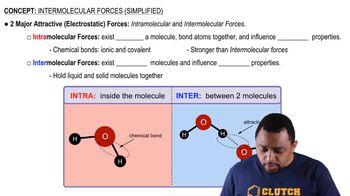
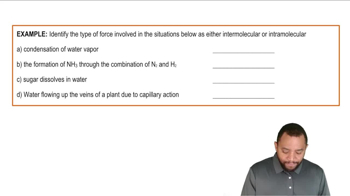
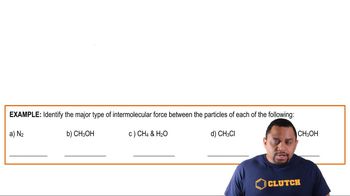
Intermolecular forces are attractions between molecules, including dipole-dipole, hydrogen bonding, and London dispersion forces.
Molarity is moles of solute per liter of solution. Molality is moles of solute per kilogram of solvent.
Freezing point depression is the lowering of a solvent's freezing point when a solute is dissolved, proportional to solute concentration.
Boiling point elevation is the increase in boiling point of a solvent caused by dissolved solute particles.
A rate law expresses the reaction rate as a function of reactant concentrations and rate constants.
Chemical equilibrium occurs when the forward and reverse reaction rates are equal, and concentrations remain constant.
K quantifies the ratio of product to reactant concentrations at equilibrium, raised to their stoichiometric coefficients.
Q is the ratio of product to reactant concentrations at any time; comparing Q to K predicts reaction direction.
Le Chatelier’s Principle says a system at equilibrium shifts to counteract changes in concentration, pressure, or temperature.
Ka is the acid dissociation constant, measuring acid strength by its tendency to donate protons.
pH measures hydrogen ion concentration; pOH measures hydroxide ion concentration; \(pH + pOH = 14\).
For strong acids, pH = -log[H+] since they fully dissociate in solution.
Ksp is the solubility product constant; molar solubility is the molar concentration of a solute that dissolves to reach saturation.
Gibbs Free Energy is \(\Delta G = \Delta H - T\Delta S\), predicting reaction spontaneity.
Oxidation is loss of electrons; reduction is gain of electrons.
Galvanic cells generate electrical energy from spontaneous reactions; electrolytic cells use electrical energy to drive non-spontaneous reactions.
Cell potential is the difference between cathode and anode potentials: \(E_{cell} = E_{cathode} - E_{anode}\).
They determine the amount of metal deposited or dissolved during electrolysis based on charge passed.
Half-life is the time required for half the nuclei in a sample to decay.
Fission splits heavy nuclei into smaller ones; fusion combines light nuclei to form heavier nuclei.
Hydrocarbons include alkanes (single bonds), alkenes (double bonds), and alkynes (triple bonds).
Isomers are compounds with the same molecular formula but different structures or arrangements.
Alkanes are named using the longest carbon chain with suffix -ane and prefixes for substituents.