 뒤로
뒤로General Chemistry: Electronegativity
 02:10
02:10
이 집합의 용어 (20)
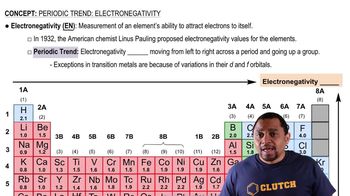
Electronegativity is the tendency of an atom to attract electrons toward itself in a chemical bond.
Electronegativity increases from left to right across a period and decreases down a group in the periodic table.
Fluorine has the highest electronegativity of all elements.
Because the nuclear charge increases, pulling electrons closer, while shielding remains similar.
Because additional electron shells increase distance and shielding, reducing the nucleus's pull on bonding electrons.
Greater difference in electronegativity between atoms leads to more polar bonds.
The Pauling scale is the most common scale for electronegativity values.
Fluorine has an electronegativity of about 3.98 on the Pauling scale.
Large electronegativity differences favor ionic bonds, while small differences favor covalent bonds.
Metals generally have low electronegativity values.
Electronegativity differences affect molecular polarity, which influences shape and chemical reactivity.
Both relate to an atom's attraction for electrons, but electronegativity refers to bonded atoms, electron affinity to isolated atoms gaining electrons.
No, electronegativity is a relative scale derived from experimental data like bond energies.
Higher electronegativity of atoms bonded to hydrogen generally increases acid strength by stabilizing the conjugate base.
Higher electronegativity usually leads to shorter bond lengths due to stronger attraction.
Greater electronegativity differences create larger dipole moments in molecules.
Electronegativity difference is typically less than 0.5 for nonpolar covalent bonds.
Differences greater than about 1.7 often indicate ionic bonding.
Atoms with higher electronegativity tend to have negative oxidation states in compounds.
It helps predict bond type, polarity, reactivity, and molecular properties.