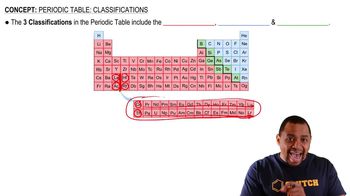
The periodic table is a chart that organizes all known chemical elements by increasing atomic number and similar chemical properties.
How are elements arranged in the periodic table?
Elements are arranged in order of increasing atomic number from left to right and top to bottom.
What are periods in the periodic table?
Periods are the horizontal rows in the periodic table, indicating elements with the same number of electron shells.
What are groups or families in the periodic table?
Groups or families are the vertical columns, containing elements with similar chemical properties and the same number of valence electrons.
What defines the chemical properties of an element?
The number of valence electrons primarily determines an element's chemical properties.
What are metals, nonmetals, and metalloids?
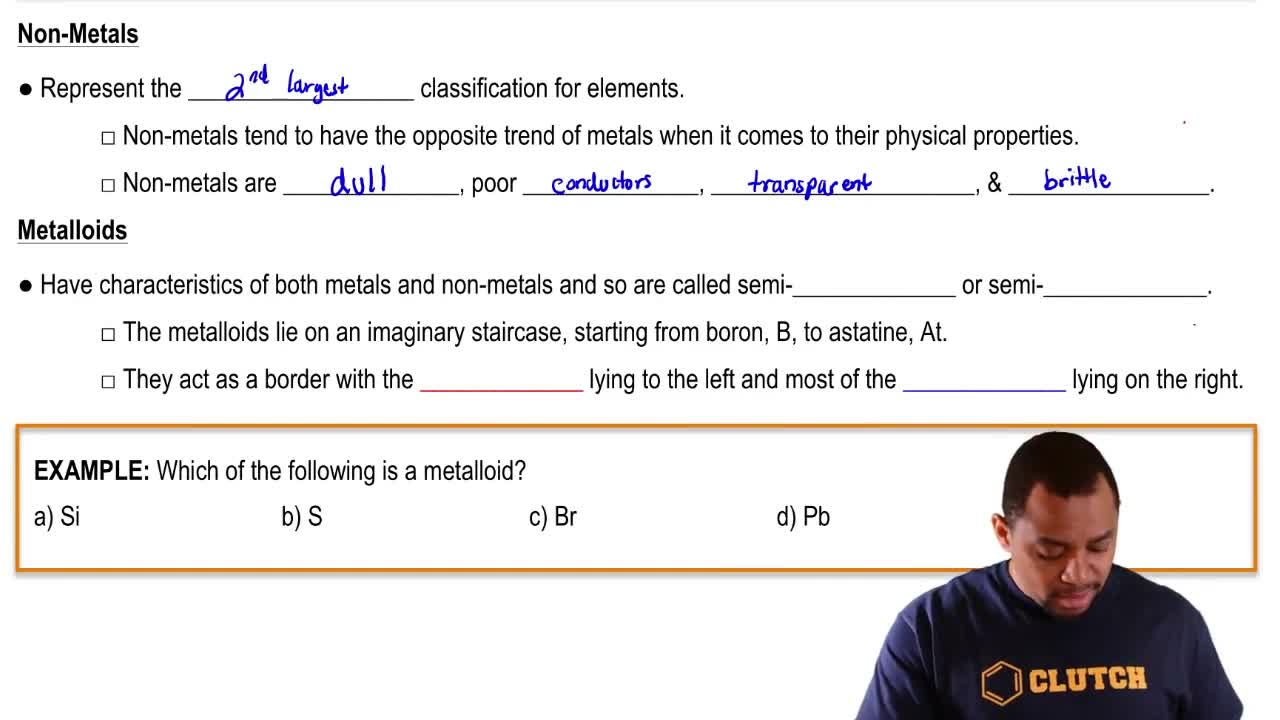
Metals are typically shiny, conductive, and malleable; nonmetals are poor conductors and brittle; metalloids have properties intermediate between metals and nonmetals.
Where are alkali metals located on the periodic table?
Alkali metals are in Group 1, excluding hydrogen, and are highly reactive metals.
What are halogens?
Halogens are elements in Group 17, known for being highly reactive nonmetals.
What is the significance of noble gases?
Noble gases in Group 18 are inert gases with a full valence shell, making them very stable and unreactive.
How does atomic radius change across a period?
Atomic radius generally decreases from left to right across a period due to increasing nuclear charge pulling electrons closer.
How does atomic radius change down a group?
Atomic radius generally increases down a group because additional electron shells are added.
What is ionization energy?
Ionization energy is the energy required to remove an electron from an atom in the gas phase.
How does ionization energy change across a period?
Ionization energy generally increases from left to right across a period due to stronger nuclear attraction.
How does ionization energy change down a group?
Ionization energy generally decreases down a group because electrons are farther from the nucleus and easier to remove.
What is electronegativity?
Electronegativity is the tendency of an atom to attract electrons in a chemical bond.
How does electronegativity change across a period?
Electronegativity generally increases from left to right across a period.
How does electronegativity change down a group?
Electronegativity generally decreases down a group.
What is the relationship between valence electrons and group number for main group elements?
For main group elements, the group number corresponds to the number of valence electrons.
What is the significance of the periodic law?
The periodic law states that the properties of elements are a periodic function of their atomic numbers.
What are transition metals?
Transition metals are elements in groups 3-12, characterized by partially filled d orbitals and variable oxidation states.
 뒤로
뒤로
 01:12
01:12