뒤로

General Chemistry: Reactions in Aqueous Solution

컨트롤 버튼이 '내비게이션' 모드로 변경되었습니다.
1/25
  • What is a solution?

    A solution is a homogeneous mixture made of two or more components with a uniform composition.
  • Define solute and solvent in a solution.

    Solute is the component dissolved in the solvent. Solvent is the component present in the largest amount that dissolves the solute.
  • What is concentration in a solution?

    Concentration measures the amount of solute in a given volume of solution.
  • Difference between suspensions, colloids, and solutions based on particle size.

    Suspensions have particles >500 nm that settle out. Colloids have particles between 1-500 nm that do not settle. Solutions have particles <1 nm and are homogeneous.
  • What is molarity and its formula?

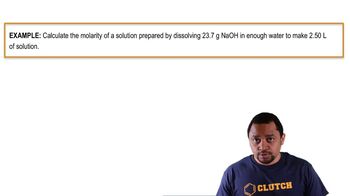
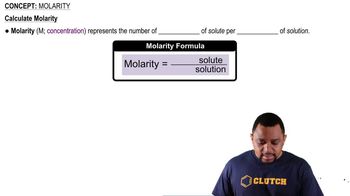
    Molarity (M) is moles of solute per liter of solution. Formula: \(M=\frac{moles\ solute}{L\ solution}\).
  • How to calculate molarity from grams of solute?

    Convert grams to moles using molar mass, then divide by solution volume in liters.
  • What is osmolarity?

    Osmolarity is the total concentration of ions in solution, calculated as number of ions times molarity of compound.
  • Formula to calculate osmolarity from molarity.

    \(Osmolarity = (number\ of\ ions) \times Molarity\).
  • What is dilution and its formula?

    Dilution is adding solvent to decrease concentration. Formula: \(M_1V_1 = M_2V_2\).
  • What are solubility rules used for?

    Solubility rules predict if ionic compounds are soluble or insoluble in water.
  • What does the mnemonic GANA CASH represent?

    GANA CASH lists soluble ionic compounds: Group 1A, NH4+, Acetates, Chlorates, Sulfates, Halides (with exceptions).
  • What are strong electrolytes?

    Strong electrolytes completely dissociate into ions in solution; include strong acids, strong bases, and soluble salts.
  • Difference between strong, weak, and non-electrolytes.

    Strong electrolytes fully dissociate; weak electrolytes partially dissociate; non-electrolytes do not dissociate into ions.
  • What is a molecular equation?

    A molecular equation shows reactants and products as intact compounds, not dissociated ions.
  • What is a precipitation reaction?

    A reaction where an insoluble ionic compound (precipitate) forms from soluble reactants.
  • What is a gas evolution reaction?

    A reaction producing a gas as one of the products, often from acid and carbonate or sulfide reactants.
  • What is solution stoichiometry?

    Calculations involving volumes and molarities of solutions to find amounts of reactants or products.
  • What is a complete ionic equation?

    An equation showing all soluble ionic compounds dissociated into their ions.
  • What is a net ionic equation?

    An equation showing only the ions and compounds directly involved in the chemical reaction, excluding spectator ions.
  • What is an oxidation number?

    The charge an atom would have if electrons were assigned according to electronegativity in a compound.
  • What is a redox reaction?

    A reaction involving transfer of electrons; oxidation is loss of electrons, reduction is gain of electrons.
  • How to balance redox reactions in acidic solution?

    Balance atoms except H and O, add H2O to balance O, add H+ to balance H, add electrons to balance charge, then combine half-reactions.
  • Additional step for balancing redox reactions in basic solution?

    After balancing as acidic, add OH– to both sides to neutralize H+, forming water, then simplify.
  • What is the activity series?

    A list of elements ranked by their ability to displace others in single displacement reactions.
  • How to predict if a single displacement reaction occurs?

    An element can displace another if it is higher in the activity series.