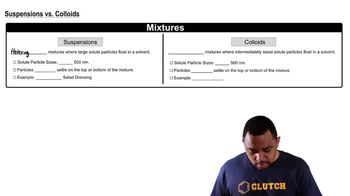
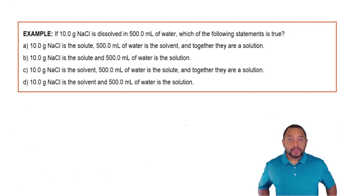
A solution is a homogeneous mixture composed of two or more different chemical substances, which may be in different phases.
Define solute and solvent.
The solute is the component being dissolved, usually the minor component, and the solvent is the major component in a solution.
What does 'like dissolves like' mean?
It means substances dissolve best in solvents with similar intermolecular forces or polarity.
What determines if a solution will form based on intermolecular forces?
A solution forms if solute-solvent attractions are strong enough to overcome solute-solute and solvent-solvent attractions, considering entropy changes.
What is solubility?
Solubility is the maximum amount of solute that can dissolve in a given amount of solvent at a specific temperature and pressure.
What is a saturated solution?
A saturated solution is one where solute and solvent are in dynamic equilibrium and no more solute dissolves.
How does temperature generally affect solubility of solids in water?
For most solids, solubility increases as temperature increases.
How does temperature affect gas solubility in water?
Gas solubility decreases as temperature increases.
What is the enthalpy of solution?
It is the overall heat change when a solution forms: ΔHsoln = ΔHsolute (endothermic) + ΔHsolvent (endothermic) + ΔHmix (exothermic).
What is a supersaturated solution?
A supersaturated solution contains more solute than the saturation limit and is unstable.
Define molarity (M).
Molarity is the amount of solute in moles divided by the volume of solution in liters.
Define molality (m).
Molality is the amount of solute in moles divided by the mass of solvent in kilograms.
What is Raoult's Law?
Raoult's Law states that the vapor pressure of a solvent in solution equals the mole fraction of the solvent times the vapor pressure of the pure solvent.
How does adding a nonvolatile solute affect vapor pressure?
It lowers the vapor pressure of the solvent by reducing the number of solvent molecules at the surface.
What is freezing point depression?
Freezing point depression is the lowering of a solvent's freezing point when a solute is dissolved, proportional to molality: ΔTf = m · kf.
What is boiling point elevation?
Boiling point elevation is the increase in boiling point of a solvent when a solute is dissolved, proportional to molality: ΔTb = m · kb.
What is the van't Hoff factor (i)?
The van't Hoff factor is the ratio of moles of solute particles to moles of formula units dissolved, accounting for ion dissociation.
Why are measured van't Hoff factors often less than theoretical values?
Because of ion pairing in solution, which reduces the number of free particles.
What are colligative properties?
Properties that depend only on the number of solute particles, not their identity, such as vapor pressure lowering, boiling point elevation, freezing point depression, and osmotic pressure.
What is osmosis?
Osmosis is the flow of solvent through a semipermeable membrane from a solution of low solute concentration to one of high solute concentration.
How is osmotic pressure (Π) calculated?
Π = MRT, where M is molarity, R is the gas constant, and T is temperature in Kelvin.
 뒤로
뒤로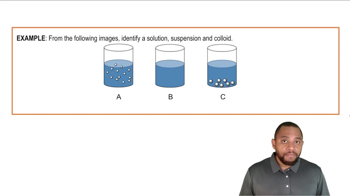
 01:16
01:16