 뒤로
뒤로General Chemistry: Water, Solutes, and Solutions
 01:16
01:16
이 집합의 용어 (20)
A compound is formed when two or more atoms from different elements join together.
Water has the chemical formula \(H_2O\), consisting of two hydrogen atoms and one oxygen atom.
The composition of water was discovered in 1784 by Henry Cavendish.
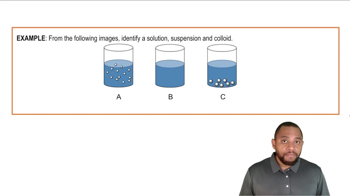
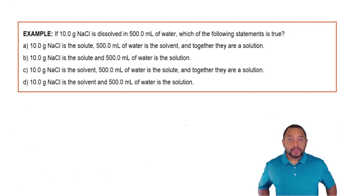
A solute is the minor component in a solution, distributed within the solvent, and can be solid, liquid, or gas.
A solvent is the major component in a solution, usually a liquid, that dissolves the solute.
The solvent is present in greater amount, while the solute is present in lesser amount in a solution.
Yes, water can act as either a solute or a solvent depending on the relative amounts in the solution.
Salt dissolves in water because both are polar, and water molecules surround and pull apart the sodium and chloride ions by breaking ionic bonds.
The positively charged side of water molecules is attracted to the negatively charged chloride ions.
The negatively charged side of water molecules is attracted to the positively charged sodium ions.
Water molecules pull sodium and chloride ions apart, breaking the ionic bonds and surrounding the ions.
The boiling point of salt is 1413 degrees Celsius.
The freezing point of salt is 801 degrees Celsius.
Water is often used as a solvent in experiments to test solubility and other chemical properties.
Water is essential for all living organisms and is involved in many biological and chemical processes.
Polarity means having positive and negative charges on different sides of a molecule, enabling interactions like dissolving salt in water.
Salt is an example of a solute that dissolves in water.
Water's polarity allows it to interact with charged ions, breaking ionic bonds and dissolving substances like salt.
Solvents are generally liquids but can also be solids or gases.
The minor component in a solution is called the solute.