Ch.11 - Liquids and Intermolecular Forces
Brown - Chemistry: The Central Science 14th Edition
Brown14th EditionChemistry: The Central ScienceISBN: 9780134414232당신이 사용하는 게 아니라요?교과서 변경
11장, 문제 16

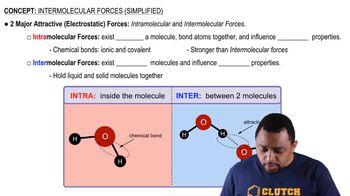
Which is generally stronger, intermolecular interactions or intramolecular interactions?

검증된 단계별 안내
1
Begin by understanding the difference between intermolecular and intramolecular interactions. Intermolecular interactions occur between molecules, while intramolecular interactions occur within a molecule, between atoms.
Consider the types of forces involved in each interaction. Intermolecular forces include van der Waals forces, dipole-dipole interactions, and hydrogen bonds. Intramolecular forces include covalent bonds, ionic bonds, and metallic bonds.
Evaluate the strength of these forces. Intramolecular forces, such as covalent bonds, are generally stronger because they involve the sharing or transfer of electrons between atoms, forming stable molecules.
Compare the energy required to break these interactions. Breaking intramolecular bonds typically requires more energy than overcoming intermolecular forces, which are weaker and more easily disrupted.
Conclude that intramolecular interactions are generally stronger than intermolecular interactions due to the nature of the forces involved and the energy required to break them.

주요 개념

질문에 올바르게 답하기 위해 반드시 이해해야 하는 핵심 개념들은 다음과 같습니다.

Intermolecular Interactions

Intermolecular interactions are forces that occur between molecules, influencing properties such as boiling and melting points. These interactions include hydrogen bonding, dipole-dipole interactions, and London dispersion forces. While they are crucial for determining the physical state and behavior of substances, they are generally weaker than intramolecular forces.
추천 영상:
가이드 코스
01:59
Intermolecular vs Intramolecular Forces

Intramolecular Interactions

Intramolecular interactions are the forces that hold atoms together within a molecule, primarily through covalent or ionic bonds. These interactions are significantly stronger than intermolecular forces, as they involve the sharing or transfer of electrons between atoms. The strength of these bonds is essential for the stability and structure of molecules.
추천 영상:
가이드 코스
01:59
Intermolecular vs Intramolecular Forces

Comparison of Strength

The comparison of strength between intermolecular and intramolecular interactions highlights that intramolecular forces are typically much stronger. This distinction is crucial in understanding chemical properties and reactions, as the stability of a molecule is largely determined by its intramolecular interactions, while intermolecular forces affect physical properties like solubility and phase changes.
추천 영상:
가이드 코스
02:11
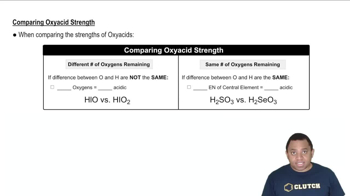
Oxyacid Strength Comparison