Ch.12 - Solids and Modern Materials
Brown - Chemistry: The Central Science 14th Edition
Brown14th EditionChemistry: The Central ScienceISBN: 9780134414232당신이 사용하는 게 아니라요?교과서 변경
12장, 문제 11

Covalent bonding occurs in both molecular and covalent-network solids. Which of the following statements best explains why these two kinds of solids differ so greatly in their hardness and melting points? (a) The molecules in molecular solids have stronger covalent bonding than covalent-network solids do. (b) The molecules in molecular solids are held together by weak intermolecular interactions. (c) The atoms in covalent-network solids are more polarizable than those in molecular solids. (d) Molecular solids are denser than covalent-network solids.

검증된 단계별 안내
1
Step 1: Understand the nature of covalent bonding in both molecular and covalent-network solids. Covalent bonds involve the sharing of electron pairs between atoms, and these bonds can form discrete molecules or extended networks.
Step 2: Analyze the structure of molecular solids. In molecular solids, individual molecules are held together by intermolecular forces such as London dispersion forces, dipole-dipole interactions, or hydrogen bonds, which are generally weaker than covalent bonds.
Step 3: Examine the structure of covalent-network solids. In covalent-network solids, atoms are bonded covalently in a continuous network throughout the material, resulting in a very strong and rigid structure.
Step 4: Compare the strength of interactions. The weak intermolecular forces in molecular solids lead to lower hardness and melting points compared to the strong covalent bonds in covalent-network solids, which contribute to their high hardness and melting points.
Step 5: Evaluate the given options. Option (b) correctly identifies that the molecules in molecular solids are held together by weak intermolecular interactions, explaining the difference in physical properties between the two types of solids.

주요 개념

질문에 올바르게 답하기 위해 반드시 이해해야 하는 핵심 개념들은 다음과 같습니다.

Covalent Bonding

Covalent bonding involves the sharing of electron pairs between atoms, leading to the formation of molecules or networks. In molecular solids, discrete molecules are held together by covalent bonds, while in covalent-network solids, atoms are interconnected in a continuous network. This difference in structure significantly influences the physical properties of the solids, such as hardness and melting points.
추천 영상:

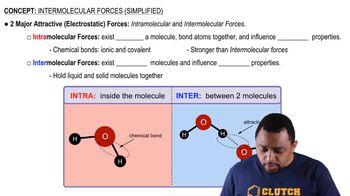
Intermolecular Forces

Intermolecular forces are the attractive forces between molecules, which are generally weaker than covalent bonds. In molecular solids, these forces include van der Waals forces and hydrogen bonds, which contribute to lower hardness and melting points compared to covalent-network solids, where strong covalent bonds throughout the structure lead to higher stability and strength.
추천 영상:
가이드 코스
01:59
Intermolecular vs Intramolecular Forces

Hardness and Melting Points

The hardness and melting points of solids are influenced by the strength and type of bonding present. Covalent-network solids, with their extensive covalent bonding, exhibit high hardness and melting points due to the strong bonds that must be broken to change their state. In contrast, molecular solids, held together by weaker intermolecular forces, tend to have lower hardness and melting points.
추천 영상:
가이드 코스
04:29
Boiling Point and Melting Point