Ch.12 - Solids and Modern Materials
Brown - Chemistry: The Central Science 14th Edition
Brown14th EditionChemistry: The Central ScienceISBN: 9780134414232당신이 사용하는 게 아니라요?교과서 변경
12장, 문제 16

Indicate the type of solid (molecular, metallic, ionic, or covalent-network) for each compound: (a) InAs, (b) MgO, (c) HgS, (d) In, (e) HBr.

검증된 단계별 안내
1
Step 1: Understand the types of solids. Molecular solids consist of molecules held together by intermolecular forces. Metallic solids are composed of metal atoms with a 'sea of electrons'. Ionic solids are formed from cations and anions held together by electrostatic forces. Covalent-network solids have atoms connected by covalent bonds in a continuous network.
Step 2: Analyze compound (a) InAs. Indium arsenide (InAs) is a compound formed from indium (a metal) and arsenic (a metalloid). It forms a covalent-network solid due to the strong covalent bonds between the atoms in a continuous lattice structure.
Step 3: Analyze compound (b) MgO. Magnesium oxide (MgO) consists of magnesium ions (Mg²⁺) and oxide ions (O²⁻). The electrostatic attraction between these oppositely charged ions forms an ionic solid.
Step 4: Analyze compound (c) HgS. Mercury(II) sulfide (HgS) is composed of mercury and sulfur. It forms an ionic solid due to the ionic bonding between Hg²⁺ and S²⁻ ions.
Step 5: Analyze compound (d) In and (e) HBr. Indium (In) is a metal, so it forms a metallic solid. Hydrogen bromide (HBr) is a molecular compound, forming a molecular solid due to the weak intermolecular forces between HBr molecules.

주요 개념

질문에 올바르게 답하기 위해 반드시 이해해야 하는 핵심 개념들은 다음과 같습니다.

Types of Solids

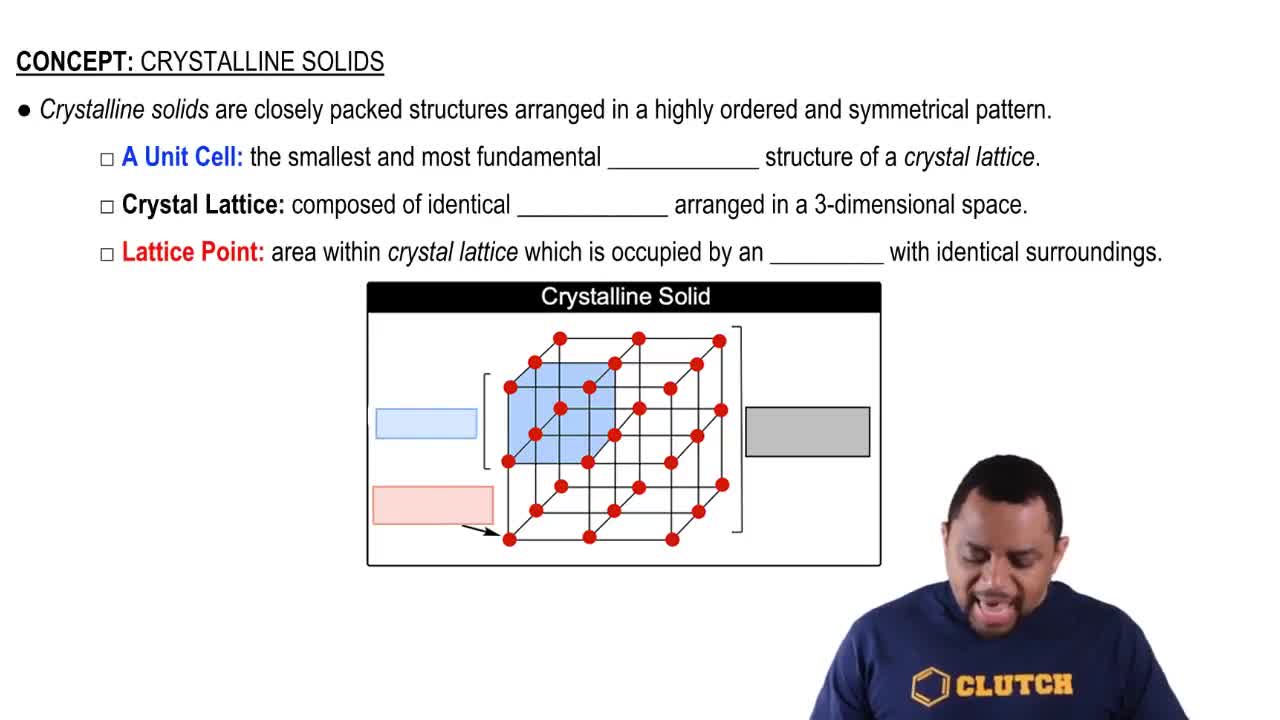
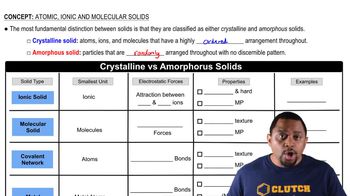
Solids can be classified into four main types: molecular, metallic, ionic, and covalent-network. Molecular solids consist of molecules held together by intermolecular forces, metallic solids are composed of metal atoms sharing electrons, ionic solids are formed from the electrostatic attraction between oppositely charged ions, and covalent-network solids consist of a continuous network of covalent bonds.
추천 영상:
가이드 코스
01:31
Crystalline Solids Structure

Ionic Compounds

Ionic compounds are formed when metals transfer electrons to nonmetals, resulting in the formation of positively and negatively charged ions. These ions are held together by strong electrostatic forces, creating a crystalline structure. Common examples include salts like sodium chloride (NaCl) and magnesium oxide (MgO), which exhibit high melting points and electrical conductivity when dissolved in water.
추천 영상:
가이드 코스
02:11
Ionic Compounds Naming

Metallic and Covalent-Network Solids

Metallic solids consist of metal atoms that are bonded by a 'sea of electrons' that allows for conductivity and malleability. In contrast, covalent-network solids, such as diamond or silicon carbide, feature atoms connected by a network of covalent bonds, resulting in very high melting points and hardness. Understanding these distinctions is crucial for classifying the given compounds.
추천 영상:
가이드 코스
04:13
Crystalline vs Amorphous Solids