Ch.13 - Properties of Solutions
Brown - Chemistry: The Central Science 14th Edition
Brown14th EditionChemistry: The Central ScienceISBN: 9780134414232당신이 사용하는 게 아니라요?교과서 변경
13장, 문제 14

Indicate whether each statement is true or false: (a) NaCl dissolves in water but not in benzene (C6H6) because benzene is denser than water. (b) NaCl dissolves in water but not in benzene because water has a large dipole moment and benzene has zero dipole moment. (c) NaCl dissolves in water but not in benzene because the water–ion interactions are stronger than benzene–ion interactions.

검증된 단계별 안내
1
Step 1: Understand the solubility principle 'like dissolves like', which means polar substances tend to dissolve in polar solvents, and nonpolar substances dissolve in nonpolar solvents.
Step 2: Analyze statement (a): Consider the density of a solvent and its relevance to solubility. Density is not a determining factor for solubility; instead, the polarity of the solvent is more significant.
Step 3: Analyze statement (b): Recognize that water is a polar solvent with a significant dipole moment, while benzene is nonpolar with a zero dipole moment. NaCl, being ionic, is more likely to dissolve in a polar solvent like water.
Step 4: Analyze statement (c): Consider the interactions between solute and solvent. Water-ion interactions (ion-dipole forces) are generally stronger than benzene-ion interactions, which are weak or nonexistent due to benzene's nonpolarity.
Step 5: Conclude the analysis by determining the truth of each statement based on the principles of solubility and intermolecular forces discussed in the previous steps.

주요 개념

질문에 올바르게 답하기 위해 반드시 이해해야 하는 핵심 개념들은 다음과 같습니다.

Polarity and Solubility

The principle of 'like dissolves like' explains that polar substances tend to dissolve in polar solvents, while nonpolar substances dissolve in nonpolar solvents. Water is a polar solvent due to its significant dipole moment, allowing it to effectively interact with and dissolve ionic compounds like NaCl. In contrast, benzene is a nonpolar solvent, which does not interact favorably with ionic compounds.
추천 영상:
가이드 코스
02:38
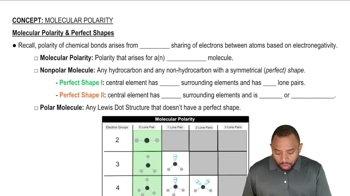
Molecular Polarity

Ionic Compounds and Solvation

Ionic compounds, such as NaCl, consist of positively and negatively charged ions. When dissolved in water, these ions are surrounded by water molecules, a process known as solvation, which stabilizes the ions in solution. The strong interactions between water molecules and the ions overcome the ionic bonds in NaCl, facilitating its dissolution.
추천 영상:
가이드 코스
02:11
Ionic Compounds Naming

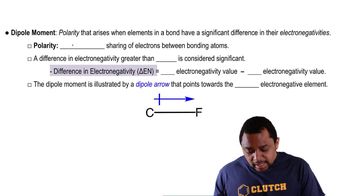
Dipole Moment

The dipole moment is a measure of the separation of positive and negative charges in a molecule, indicating its polarity. Water has a high dipole moment due to its bent shape and electronegative oxygen atom, making it an effective solvent for ionic compounds. In contrast, benzene has a zero dipole moment, rendering it ineffective for dissolving ionic substances like NaCl.
추천 영상: