When ammonium chloride dissolves in water, the solution becomes colder. (a) Is the solution process exothermic or endothermic?
Ch.13 - Properties of Solutions
13장, 문제 18b
When ammonium chloride dissolves in water, the solution becomes colder. (b) Why does the solution form?
검증된 단계별 안내1
Identify the process: Dissolution of ammonium chloride (NH_4Cl) in water is an endothermic process, meaning it absorbs heat from the surroundings.
Understand the energy changes: The dissolution involves breaking ionic bonds in NH_4Cl and forming new interactions between NH_4^+ and Cl^- ions with water molecules.
Consider entropy: The process increases the disorder or randomness (entropy) of the system, as the solid NH_4Cl becomes dispersed ions in solution.
Apply Gibbs Free Energy: Use the equation \( \Delta G = \Delta H - T\Delta S \) to determine spontaneity. Even if \( \Delta H \) is positive (endothermic), a large positive \( \Delta S \) can make \( \Delta G \) negative, favoring the formation of the solution.
Conclude with spontaneity: The increase in entropy and the resulting negative \( \Delta G \) make the dissolution of NH_4Cl in water spontaneous, despite the absorption of heat.

비슷한 문제에 대한 검증된 영상 답변:
이 영상 해법은 위 문제에 도움이 된다고 튜터들이 추천한 것입니다.
영상 길이:
1m도움이 되었나요?
주요 개념
질문에 올바르게 답하기 위해 반드시 이해해야 하는 핵심 개념들은 다음과 같습니다.
Dissolution Process
The dissolution process involves the breaking apart of solute particles and their interaction with solvent molecules. In the case of ammonium chloride (NH4Cl), when it dissolves in water, the ionic bonds between the ammonium and chloride ions are broken, allowing them to disperse throughout the water. This process requires energy, which is absorbed from the surroundings, leading to a decrease in temperature.
추천 영상:
가이드 코스
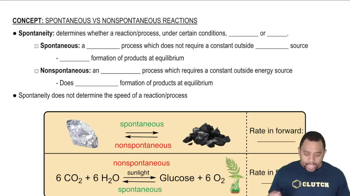
Spontaneity of Processes
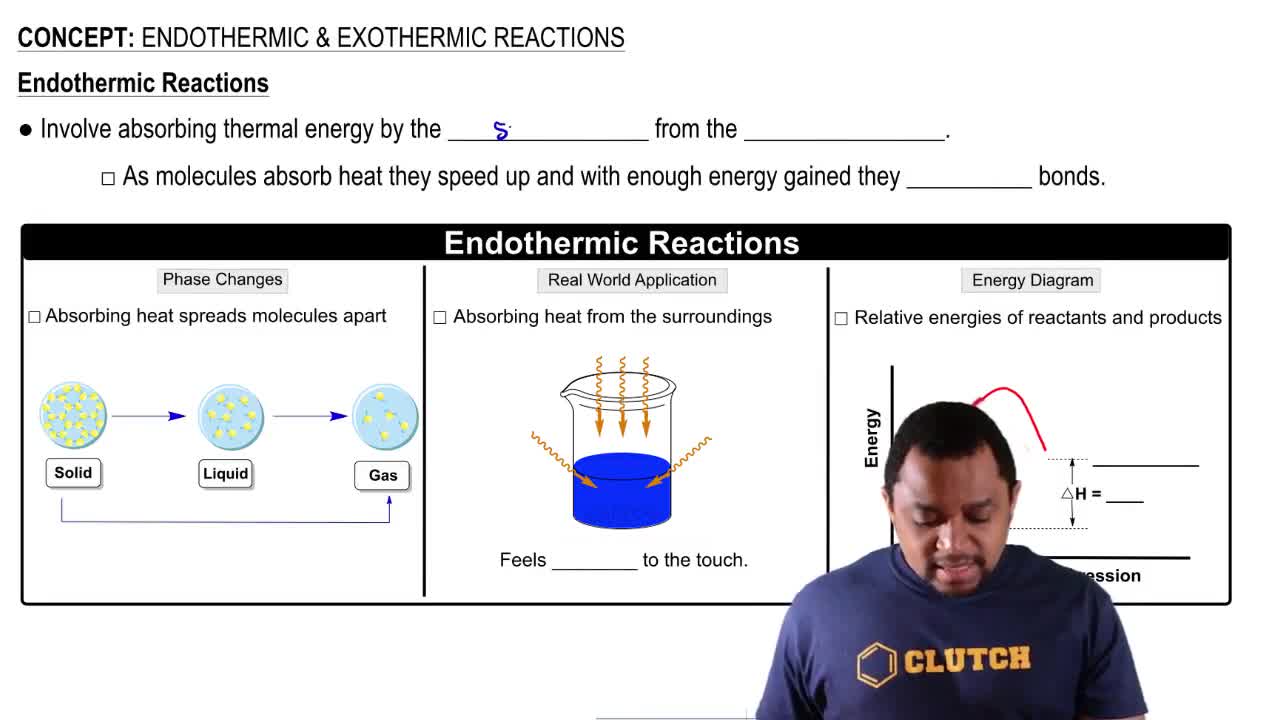
Endothermic Reactions
An endothermic reaction is a chemical process that absorbs heat from its surroundings. The dissolution of ammonium chloride in water is an example of this type of reaction, as it requires energy to break the ionic bonds and separate the ions. As a result, the surrounding water loses heat, causing the temperature of the solution to drop.
추천 영상:
가이드 코스
Endothermic & Exothermic Reactions
Thermodynamics of Solutions
Thermodynamics in the context of solutions refers to the energy changes that occur during the mixing of solutes and solvents. The overall energy change during dissolution is determined by the balance between the energy required to break solute-solute and solvent-solvent interactions and the energy released from solute-solvent interactions. In the case of ammonium chloride, the energy absorbed during dissolution exceeds the energy released, resulting in a colder solution.
추천 영상:
가이드 코스
First Law of Thermodynamics
관련 실천
교과서 질문
1262
views
교과서 질문
For the dissolution of LiCl in water, ∆Hsoln = -37 kJ/mol. Which term would you expect to be the largest negative number: ∆Hsolvent, ∆Hsolute, or ∆Hmix?
교과서 질문
The first stage of treatment at the reverse osmosis plant in Carlsbad, California, is to flow the water through rock, sand, and gravel as shown here. Would this step remove particulate matter? Would this step remove dissolved salts?
[Section 18.4]
110
views
교과서 질문
Two nonpolar organic liquids, hexane (C6H14) and heptane (C7H16), are mixed. (a) Do you expect ∆Hsoln to be a large positive number, a large negative number, or close to zero? Explain.
1159
views
교과서 질문
An ionic compound has a very negative ∆Hsoln in water (b) Which term would you expect to be the largest negative number: ∆Hsolvent, ∆Hsolute, or ∆Hmix?
675
views