Consider a reaction A2(𝑔) + B2(𝑔) ⇌ 2 AB(𝑔), atoms of A shown in red in the diagram and atoms of B shown in blue. (a) If 𝐾𝑐 = 1, which box represents the system at equilibrium?
Ch.19 - Chemical Thermodynamics
19장, 문제 8
Using data from Appendix C, write the equilibrium-constant expression and calculate the value of the equilibrium constant and the free-energy change for these reactions at 298 K: (b) 2 HBr(g) + Cl2(g) ⇌ 2 HCl(g) + Br2(g) (c) 2 SO2(g) + O2(g) ⇌ 2 SO3(g)
검증된 단계별 안내1
Step 1: Write the equilibrium-constant expression for each reaction. For a general reaction aA + bB ⇌ cC + dD, the equilibrium constant expression Kc is given by \( K_c = \frac{[C]^c[D]^d}{[A]^a[B]^b} \). Apply this to each reaction.
Step 2: For reaction (b) 2 HBr(g) + Cl2(g) ⇌ 2 HCl(g) + Br2(g), the equilibrium-constant expression is \( K_c = \frac{[HCl]^2[Br_2]}{[HBr]^2[Cl_2]} \).
Step 3: For reaction (c) 2 SO2(g) + O2(g) ⇌ 2 SO3(g), the equilibrium-constant expression is \( K_c = \frac{[SO_3]^2}{[SO_2]^2[O_2]} \).
Step 4: Use the standard Gibbs free energy change equation \( \Delta G^\circ = -RT \ln K \) to relate the equilibrium constant to the free energy change. Here, R is the gas constant (8.314 J/mol·K) and T is the temperature in Kelvin (298 K).
Step 5: Calculate \( \Delta G^\circ \) for each reaction using \( \Delta G^\circ = \sum \Delta G^\circ_{\text{products}} - \sum \Delta G^\circ_{\text{reactants}} \) with values from Appendix C, then solve for K using \( K = e^{-\Delta G^\circ / RT} \).
주요 개념
질문에 올바르게 답하기 위해 반드시 이해해야 하는 핵심 개념들은 다음과 같습니다.
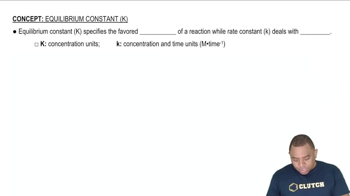
Equilibrium Constant (K)
The equilibrium constant (K) is a numerical value that expresses the ratio of the concentrations of products to reactants at equilibrium for a given reaction at a specific temperature. It is derived from the balanced chemical equation and is calculated using the formula K = [products]^[coefficients] / [reactants]^[coefficients]. A large K value indicates that products are favored at equilibrium, while a small K value suggests that reactants are favored.
추천 영상:
가이드 코스
Equilibrium Constant K
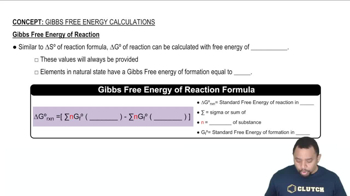
Gibbs Free Energy (ΔG)
Gibbs free energy (ΔG) is a thermodynamic quantity that indicates the spontaneity of a reaction at constant temperature and pressure. It is calculated using the equation ΔG = ΔG° + RT ln(Q), where ΔG° is the standard free energy change, R is the universal gas constant, T is the temperature in Kelvin, and Q is the reaction quotient. A negative ΔG indicates a spontaneous reaction, while a positive ΔG suggests non-spontaneity.
추천 영상:
가이드 코스
Gibbs Free Energy of Reactions
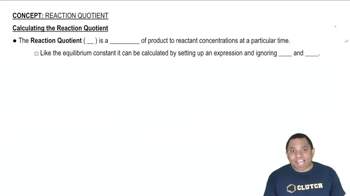
Reaction Quotient (Q)
The reaction quotient (Q) is a measure of the relative concentrations of products and reactants at any point in a reaction, not necessarily at equilibrium. It is calculated similarly to the equilibrium constant but uses the current concentrations instead of equilibrium concentrations. Comparing Q to K helps predict the direction in which a reaction will proceed to reach equilibrium: if Q < K, the reaction will shift to the right (toward products), and if Q > K, it will shift to the left (toward reactants).
추천 영상:
가이드 코스
Reaction Quotient Q
관련 실천
교과서 질문
319
views
교과서 질문
The accompanying diagram shows how ΔH (red line) and TΔS (blue line) change with temperature for a hypothetical reaction.
(b) In what temperature range is this reaction spontaneous?
519
views
교과서 질문
Consider a reaction A2(𝑔) + B2(𝑔) ⇌ 2 AB(𝑔), atoms of A shown in red in the diagram and atoms of B shown in blue. (b) If 𝐾𝑐 = 1, which box represents the system at 𝑄 < 𝐾𝑐?
496
views
교과서 질문
Isomers are molecules that have the same chemical formula but different arrangements of atoms, as shown here for two isomers of pentane, C5H12.
(b) Which isomer do you expect to have the higher standard molar entropy? Explain.
828
views