Ch.20 - Electrochemistry
Brown - Chemistry: The Central Science 14th Edition
Brown14th EditionChemistry: The Central ScienceISBN: 9780134414232당신이 사용하는 게 아니라요?교과서 변경
20장, 문제 19b,c

Indicate whether the following balanced equations involve oxidation–reduction. If they do, identify the elements that undergo changes in oxidation number. (b) NaI(aq) + 3 HOCl(aq) → NaIO3(aq) + 3 HCl(aq) (c) 3 SO(1g) + 2 HNO3(aq) + 2 H2O(l) → 3 H2SO4(aq) + 2 NO(g)

검증된 단계별 안내
1
Determine the oxidation states of each element in the reactants and products.
For NaI, Na is in the +1 oxidation state and I is in the -1 oxidation state.
For HOCl, H is in the +1 oxidation state, O is in the -2 oxidation state, and Cl is in the +1 oxidation state.
For NaIO_3, Na is in the +1 oxidation state, I is in the +5 oxidation state, and O is in the -2 oxidation state.
For HCl, H is in the +1 oxidation state and Cl is in the -1 oxidation state.

비슷한 문제에 대한 검증된 영상 답변:

이 영상 해법은 위 문제에 도움이 된다고 튜터들이 추천한 것입니다.
영상 길이:
4m
도움이 되었나요?

주요 개념

질문에 올바르게 답하기 위해 반드시 이해해야 하는 핵심 개념들은 다음과 같습니다.

Oxidation-Reduction Reactions

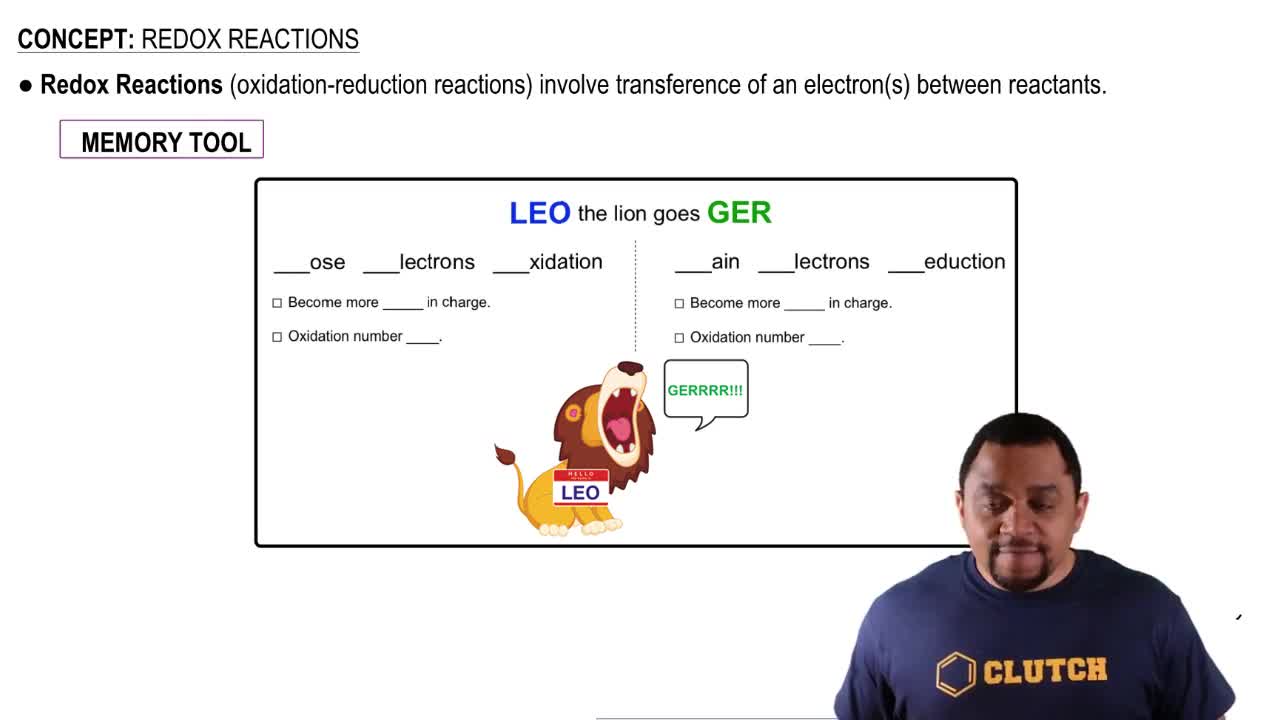
Oxidation-reduction (redox) reactions involve the transfer of electrons between substances, resulting in changes in oxidation states. In these reactions, oxidation refers to the loss of electrons, while reduction refers to the gain of electrons. Identifying whether a reaction is a redox process requires analyzing the oxidation states of the elements involved before and after the reaction.
추천 영상:
가이드 코스
01:53
Oxidation and Reduction Reactions

Oxidation States

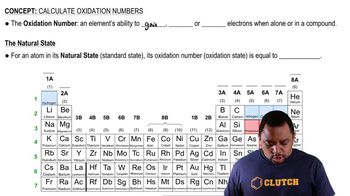
Oxidation states (or oxidation numbers) are assigned to elements in a compound to indicate their degree of oxidation or reduction. The oxidation state of an element can change during a chemical reaction, which is crucial for identifying redox processes. Common rules for determining oxidation states include that the oxidation state of an element in its elemental form is zero, and for monoatomic ions, it is equal to the charge of the ion.
추천 영상:
가이드 코스
02:42
Oxidation Numbers

Balancing Chemical Equations

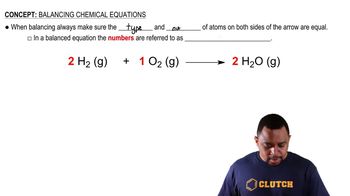
Balancing chemical equations ensures that the number of atoms for each element is the same on both sides of the equation, reflecting the conservation of mass. In redox reactions, balancing often involves ensuring that both the number of electrons lost in oxidation and gained in reduction are equal. This process may require adjusting coefficients in front of compounds to achieve balance while maintaining the correct stoichiometry.
추천 영상:
가이드 코스
01:32
Balancing Chemical Equations
관련 실천
교과서 질문

Indicate whether the following balanced equations involve oxidation–reduction. If they do, identify the elements that undergo changes in oxidation number. (a) 2 AgNO3(aq) + CoCl2(aq) → 2 AgCl(s) + Co(NO3)2(aq)

568
views

교과서 질문

Indicate whether the following balanced equations involve oxidation–reduction. If they do, identify the elements that undergo changes in oxidation number. (a) PBr3(l) + 3 H2O(l) → H3PO3(aq) + 3 HBr(aq)

564
views
교과서 질문

For each of the following balanced oxidation–reduction reactions, (i) identify the oxidation numbers for all the elements in the reactants and products and (ii) state the total number of electrons transferred in each reaction. (a) I2O5(s) + 5 CO(g) → I2(s) + 5 CO2(g) (b) 2 Hg2+(aq) + N2H4(aq) → 2 Hg(l) + N2(g) + 4 H+(aq) (c) 3 H2S(aq) + 2 H+(aq) + 2 NO3-(aq) → 3 S(s) + 2 NO(g) + 4 H2O(l)

554
views
교과서 질문

At 900 °C, titanium tetrachloride vapor reacts with molten magnesium metal to form solid titanium metal and molten magnesium chloride. (a) Write a balanced equation for this reaction.

1236
views
1
comments
교과서 질문

At 900 °C, titanium tetrachloride vapor reacts with molten magnesium metal to form solid titanium metal and molten magnesium chloride (c) Which substance is the reductant, and which is the oxidant?

교과서 질문

For each of the following balanced oxidation–reduction reactions, (i) identify the oxidation numbers for all the elements in the reactants and products and (ii) state the total number of electrons transferred in each reaction. (a) 2 MnO4-(aq) + 3 S2-(aq + 4 H2O(l) → 3 S(s) + 2 MnO2(s) + 8 OH-(aq) (b) 4 H2O2(aq) + Cl2O7(g) + 2 OH-(aq) → 2 ClO2-(aq) + 5 H2O(l) + 4 O2(g) (c) Ba2+(aq) + 2 OH-(aq) + H2O2(aq) + 2 ClO2(aq) → Ba(ClO2)2(s) + 2 H2O(l) + O2(g)

718
views