
Ch.5 - Thermochemistry
Brown - Chemistry: The Central Science 14th Edition
Brown14th EditionChemistry: The Central ScienceISBN: 9780134414232당신이 사용하는 게 아니라요?교과서 변경
5장, 문제 15

(b) The force of gravity acting between two objects is given by the equation F = G * (m1 * m2) / d^2, where G is the gravitational constant, G = 6.674 * 10^-11 N*m^2/kg^2, m1 and m2 are the masses of the two objects, and d is the distance separating them. What is the gravitational force of attraction (in Newtons) between the electron and proton? (c) How many times larger is the electrostatic force of attraction?

검증된 단계별 안내
1
Identify the given values: the gravitational constant \( G = 6.674 \times 10^{-11} \text{ N} \cdot \text{m}^2/\text{kg}^2 \), the mass of an electron \( m_e = 9.109 \times 10^{-31} \text{ kg} \), the mass of a proton \( m_p = 1.673 \times 10^{-27} \text{ kg} \), and the typical distance between an electron and a proton in a hydrogen atom, approximately \( d = 5.29 \times 10^{-11} \text{ m} \).
Substitute the known values into the gravitational force equation: \( F = G \cdot \frac{m_1 \cdot m_2}{d^2} \). Here, \( m_1 = m_e \) and \( m_2 = m_p \).
Calculate the gravitational force \( F \) by substituting the values: \( F = 6.674 \times 10^{-11} \cdot \frac{(9.109 \times 10^{-31}) \cdot (1.673 \times 10^{-27})}{(5.29 \times 10^{-11})^2} \).
To find the electrostatic force, use Coulomb's law: \( F_e = k \cdot \frac{|q_1 \cdot q_2|}{d^2} \), where \( k = 8.988 \times 10^9 \text{ N} \cdot \text{m}^2/\text{C}^2 \) is Coulomb's constant, and \( q_1 = q_2 = 1.602 \times 10^{-19} \text{ C} \) are the charges of the electron and proton.
Calculate the electrostatic force \( F_e \) and then determine how many times larger it is than the gravitational force by dividing \( F_e \) by \( F \).

주요 개념

질문에 올바르게 답하기 위해 반드시 이해해야 하는 핵심 개념들은 다음과 같습니다.

Gravitational Force

The gravitational force is the attractive force between two masses, described by Newton's law of universal gravitation. It is directly proportional to the product of the masses and inversely proportional to the square of the distance between their centers. In this context, the equation F = G * (m1 * m2) / d^2 quantifies this force, where G is the gravitational constant.
추천 영상:
가이드 코스
06:44
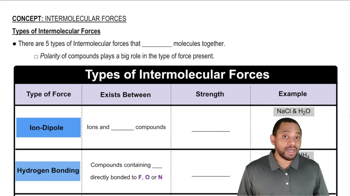
Types of Intermolecular Forces

Electrostatic Force

The electrostatic force is the force of attraction or repulsion between charged particles, described by Coulomb's law. This force is directly proportional to the product of the magnitudes of the charges and inversely proportional to the square of the distance between them. It is significantly stronger than gravitational force at the atomic level, which is crucial for understanding interactions between subatomic particles like electrons and protons.
추천 영상:
가이드 코스
01:59
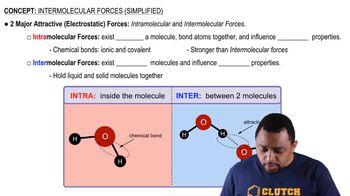
Intermolecular vs Intramolecular Forces

Comparison of Forces

Comparing gravitational and electrostatic forces involves calculating the ratio of the two forces acting between the same pair of particles. This comparison highlights the relative strength of these fundamental forces, illustrating that while gravity is a universal force, electrostatic interactions dominate at the scale of atoms and molecules, influencing chemical bonding and structure.
추천 영상:
가이드 코스
06:44
Types of Intermolecular Forces