
Ch.5 - Thermochemistry
Brown - Chemistry: The Central Science 14th Edition
Brown14th EditionChemistry: The Central ScienceISBN: 9780134414232당신이 사용하는 게 아니라요?교과서 변경
5장, 문제 10b

(b) Why does increasing the temperature cause a solid substance to change in succession from a solid to a liquid to a gas?

검증된 단계별 안내
1
1. The process of a solid changing to a liquid and then to a gas involves the addition of heat energy. This is because heat energy is required to overcome the forces of attraction between the particles in the solid.
2. When a solid is heated, the kinetic energy of its particles increases. This causes the particles to vibrate more vigorously, which weakens the forces of attraction holding them in fixed positions. As a result, the solid melts and becomes a liquid.
3. If the liquid is heated further, the kinetic energy of the particles continues to increase. This causes the particles to move even faster, breaking the forces of attraction between them completely. As a result, the liquid boils and becomes a gas.
4. In summary, increasing the temperature of a substance adds energy to its particles. This energy is used to overcome the forces of attraction between the particles, causing the substance to change from a solid to a liquid to a gas.
5. This process is known as phase transition, and it's a fundamental concept in the study of matter and its properties in chemistry.

비슷한 문제에 대한 검증된 영상 답변:

이 영상 해법은 위 문제에 도움이 된다고 튜터들이 추천한 것입니다.
영상 길이:
1m
도움이 되었나요?

주요 개념

질문에 올바르게 답하기 위해 반드시 이해해야 하는 핵심 개념들은 다음과 같습니다.

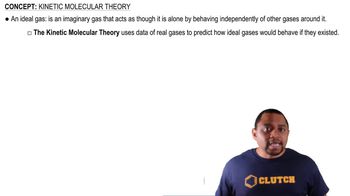
Kinetic Molecular Theory

The Kinetic Molecular Theory explains the behavior of particles in different states of matter. It posits that as temperature increases, the kinetic energy of particles also increases, causing them to move more vigorously. This increased motion leads to the breaking of intermolecular forces, allowing solids to melt into liquids and liquids to vaporize into gases.
추천 영상:
가이드 코스
01:19
Kinetic Molecular Theory

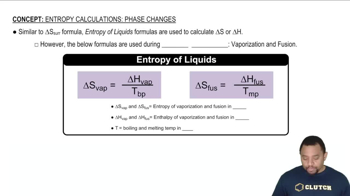
Phase Changes

Phase changes refer to the transitions between solid, liquid, and gas states of matter. These changes occur at specific temperatures known as melting and boiling points. When a solid is heated, it absorbs energy, which facilitates the transition to a liquid state, and further heating allows the liquid to transition to a gaseous state.
추천 영상:
가이드 코스
01:46
Entropy in Phase Changes

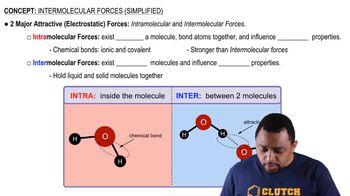
Intermolecular Forces

Intermolecular forces are the attractive forces between molecules that influence the physical properties of substances. In solids, these forces are strong, keeping particles closely packed. As temperature rises, these forces weaken, enabling the solid to melt into a liquid and eventually allowing the liquid to evaporate into a gas.
추천 영상:
가이드 코스
01:59
Intermolecular vs Intramolecular Forces