
Ch.1 - Introduction: Matter, Energy, and Measurement
Brown - Chemistry: The Central Science 14th Edition
Brown14th EditionChemistry: The Central ScienceISBN: 9780134414232당신이 사용하는 게 아니라요?교과서 변경
1장, 문제 36

(a) What is the mass of a silver cube whose edges measure 2.00 cm each at 25 _x001F_C? The density of silver is 10.49 g/cm3 at 25 _x001F_C. (b) The density of aluminum is 2.70 g/cm3 at 25 _x001F_C. What is the weight of the aluminum foil with an area of 0.5 m2 and a thickness of 0.5 mm?

검증된 단계별 안내
1
Calculate the volume of the silver cube using the formula for the volume of a cube: \( V = a^3 \), where \( a \) is the edge length of the cube. For a cube with edges of 2.00 cm, substitute the value into the formula.
Use the density formula \( \text{Density} = \frac{\text{Mass}}{\text{Volume}} \) to find the mass of the silver cube. Rearrange the formula to solve for mass: \( \text{Mass} = \text{Density} \times \text{Volume} \). Substitute the known values for density and volume.
Convert the area of the aluminum foil from square meters to square centimeters, as the density is given in g/cm³. Use the conversion factor: 1 m² = 10,000 cm².
Convert the thickness of the aluminum foil from millimeters to centimeters, as the density is given in g/cm³. Use the conversion factor: 1 mm = 0.1 cm.
Calculate the volume of the aluminum foil using the formula \( V = \text{Area} \times \text{Thickness} \). Then, use the density formula to find the mass: \( \text{Mass} = \text{Density} \times \text{Volume} \). Substitute the known values for density and volume.

주요 개념

질문에 올바르게 답하기 위해 반드시 이해해야 하는 핵심 개념들은 다음과 같습니다.

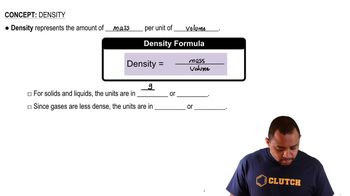
Density

Density is defined as mass per unit volume, typically expressed in grams per cubic centimeter (g/cm³) in chemistry. It is a crucial property that helps determine how much mass is contained in a given volume of a substance. In this question, the densities of silver and aluminum are provided, which are essential for calculating the mass of the silver cube and the weight of the aluminum foil.
추천 영상:
가이드 코스
01:56
Density Concepts

Volume Calculation

To find the mass of an object using its density, one must first calculate its volume. For a cube, the volume is determined by cubing the length of one edge (V = edge³). In this case, the volume of the silver cube with edges measuring 2.00 cm must be calculated to find its mass using the given density.
추천 영상:
가이드 코스
02:35
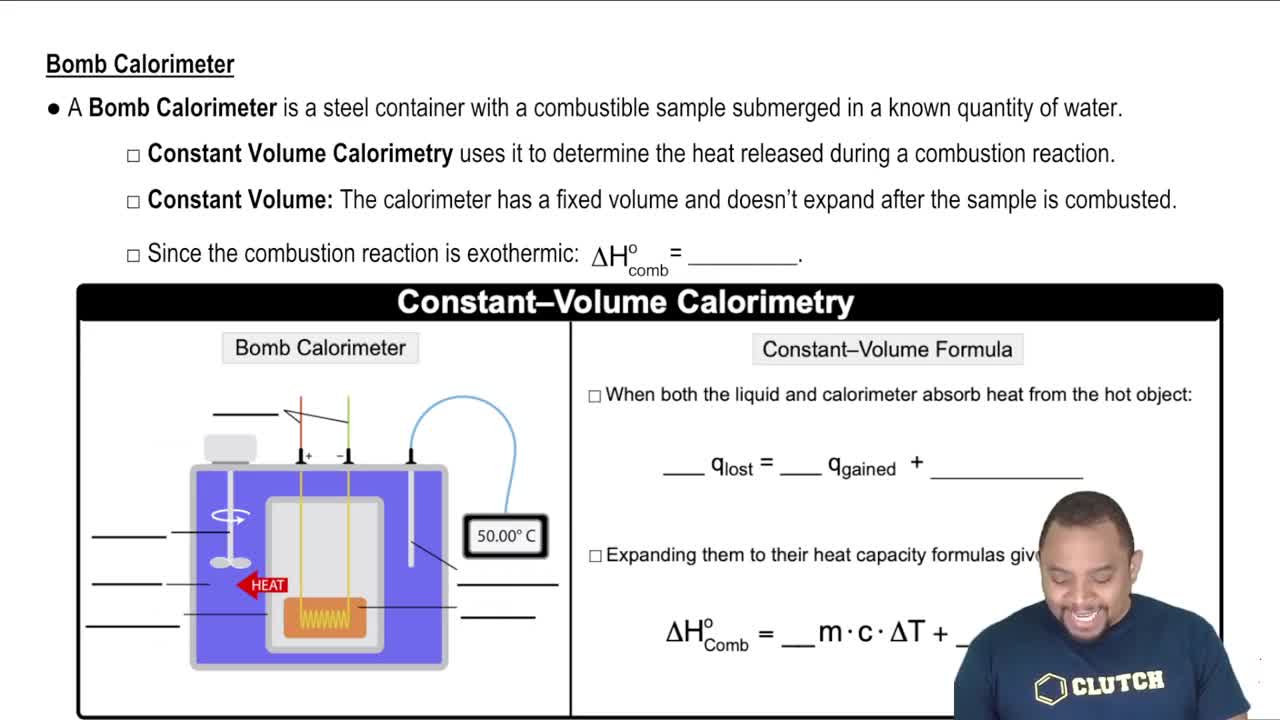
Constant-Volume Calorimetry

Weight Calculation

Weight is the force exerted by gravity on an object and can be calculated by multiplying the mass of the object by the acceleration due to gravity (W = mg). In the context of the aluminum foil, its mass can be derived from its volume (area × thickness) and density, allowing for the calculation of its weight in a straightforward manner.
추천 영상:
가이드 코스
03:45
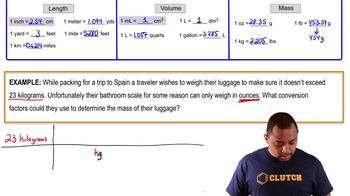
Weight Conversion Example
관련 실천
교과서 질문

(b) Carbon dioxide (CO2) is a gas at room temperature and pressure. However, carbon dioxide can be put under pressure to become a 'supercritical fluid' that is a much safer dry-cleaning agent than tetrachloroethylene. At a certain pressure, the density of supercritical CO2 is 0.469 g/cm3. What is the mass of a 25.0-mL sample of supercritical CO2 at this pressure?

1664
views
교과서 질문

(c) Is a graduated cylinder such as that shown in Figure 1.21 likely to afford the accuracy of measurement needed?

635
views
교과서 질문

(a) A sample of tetrachloroethylene, a liquid used in dry cleaning that is being phased out because of its potential to cause cancer, has a mass of 40.55 g and a volume of 25.0 mL at 25 °C. What is its density at this temperature? Will tetrachloroethylene float on water? (Materials that are less dense than water will float.)

1302
views
교과서 질문

(b) An experiment requires 45.0 g of ethylene glycol, a liquid whose density is 1.114 g/mL. Rather than weigh the sample on a balance, a chemist chooses to dispense the liquid using a graduated cylinder. What volume of the liquid should he use?

1037
views
교과서 질문

(c) During winter, the temperature of the Arctic region can drop below -50 °C, what is the temperature in degree Fahrenheit and in Kelvin? (d) The sublimation temperature of dry ice is -78.5 °C. Convert this temperature to degree Fahrenheit and Kelvin. (e) Ethanol boils at 351 K. Convert this temperature to degree Fahrenheit and degree Celsius.

교과서 질문

(a) To identify a liquid substance, a student determined its density. Using a graduated cylinder, she measured out a 45-mL sample of the substance. She then measured the mass of the sample, finding that it weighed 38.5 g. She knew that the substance had to be either isopropyl alcohol 1density 0.785 g/mL2 or toluene (density 0.866 g/mL). What are the calculated density and the probable identity of the substance?

1320
views