Judge the following statements as true or false. If you believe a statement to be false, provide a corrected version. (i) Compounds always contain at least two different elements.
Ch.1 - Introduction: Matter, Energy, and Measurement
1장, 문제 94b
In 2009, a team from Northwestern University and Western Washington University reported the preparation of a new 'spongy' material composed of nickel, molybdenum, and sulfur that excels at removing mercury from water. The density of this new material is 0.20 g/cm3, and its surface area is 1242 m2 per gram of material. (b) Calculate the surface area for a 10.0-mg sample of this material.
검증된 단계별 안내1
Convert the mass of the sample from milligrams to grams by dividing by 1000, since there are 1000 milligrams in a gram.
Use the given surface area per gram of material, which is 1242 m^2/g, to find the total surface area for the sample.
Multiply the mass of the sample in grams by the surface area per gram to calculate the total surface area.
Ensure that the units are consistent and correctly cancel out to leave the final answer in square meters.
Review the calculation to ensure that all steps have been followed correctly and that the units are appropriate.

비슷한 문제에 대한 검증된 영상 답변:
이 영상 해법은 위 문제에 도움이 된다고 튜터들이 추천한 것입니다.
영상 길이:
1m주요 개념
질문에 올바르게 답하기 위해 반드시 이해해야 하는 핵심 개념들은 다음과 같습니다.
Surface Area to Mass Ratio
The surface area to mass ratio is a critical concept in material science, particularly for porous materials. It describes how much surface area is available per unit of mass, which can significantly influence the material's reactivity and absorption capabilities. In this case, the high surface area of the spongy material allows for more effective interaction with contaminants like mercury in water.
추천 영상:
가이드 코스
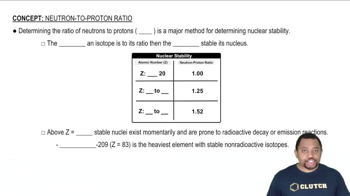
Neutron-Proton Ratio
Unit Conversion
Unit conversion is essential in chemistry for ensuring that measurements are consistent and compatible. In this problem, converting the mass of the sample from milligrams to grams is necessary to align with the surface area measurement given in square meters per gram. Understanding how to convert between different units is fundamental for accurate calculations.
추천 영상:
가이드 코스
Conversion Factors
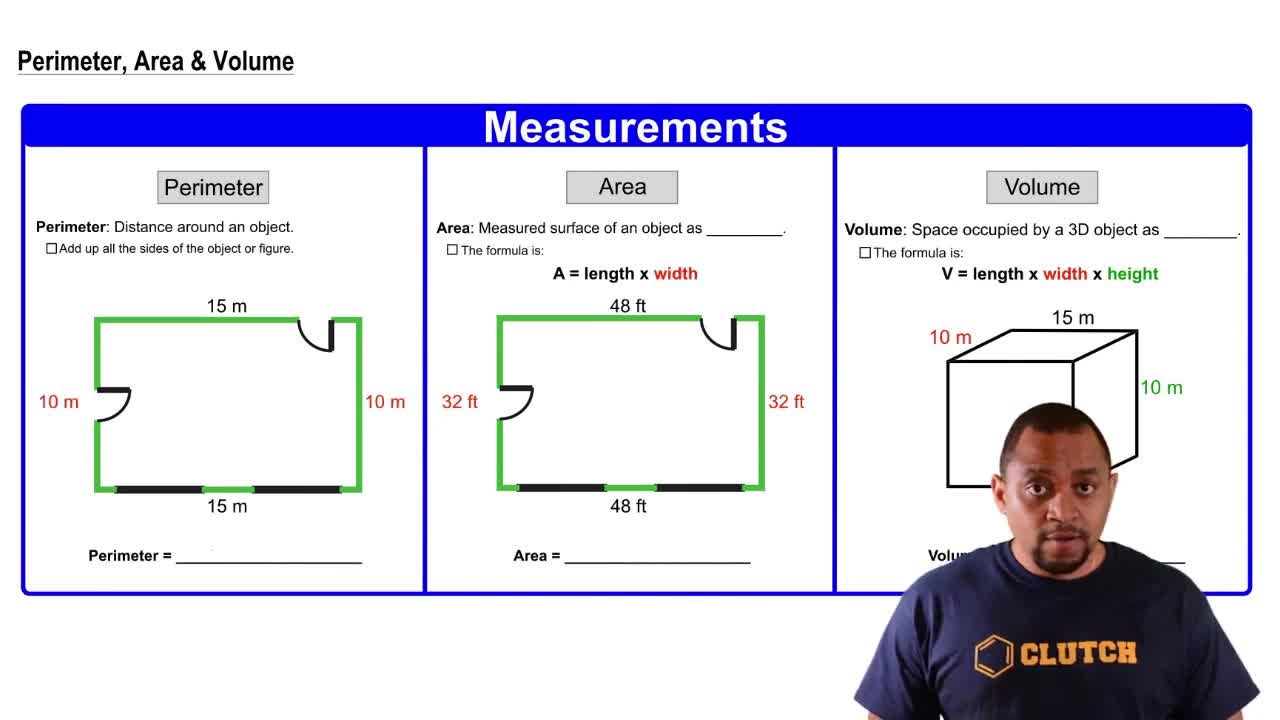
Calculation of Surface Area
Calculating the surface area of a sample involves multiplying the surface area per gram by the mass of the sample in grams. This straightforward mathematical operation allows us to determine how much surface area is available for interaction with substances in the environment, which is crucial for applications like water purification.
추천 영상:
가이드 코스
Perimeter, Area, Volume
관련 실천
교과서 질문
630
views
교과서 질문
U.S. 1-cent coin (a penny) has a diameter of 19 mm and a
thickness of 1.5 mm. Assume the coin is made of pure copper,
whose density and approximate market price are 8.9 g/cm3
and \$2.40 per pound, respectively. Calculate the value of
the copper in the coin, assuming its thickness is uniform.
2383
views
교과서 질문
You are assigned the task of separating a desired granular material with a density of 3.62 g/cm3 from an undesired granular material that has a density of 2.04 g/cm3. You want to do this by shaking the mixture in a liquid in which the heavier material will fall to the bottom and the lighter material will float. A solid will float on any liquid that is more dense. Using an Internet-based source or a handbook of chemistry, find the densities of the following substances: carbon tetrachloride, hexane, benzene, and diiodomethane. Which of these liquids will serve your purpose, assuming no chemical interaction takes place between the liquid and the solids?
724
views
교과서 질문
(c) Using the
volume of a silver atom and the formula for the volume of a
sphere, calculate the radius in angstroms of a silver atom.
754
views