Ch.1 - Introduction: Matter, Energy, and Measurement
Brown - Chemistry: The Central Science 14th Edition
Brown14th EditionChemistry: The Central ScienceISBN: 9780134414232당신이 사용하는 게 아니라요?교과서 변경
1장, 문제 32c

Use appropriate metric prefixes to write the following measurements without use of exponents: (a) 7.29×10⁶ g (b) 6.1×10⁻¹⁰ m (c) 1.828×10⁻³ s

검증된 단계별 안내
1
Identify the metric prefix that corresponds to the exponent -3. In this case, the prefix 'milli' (m) represents 10^{-3}.
Rewrite the given measurement using the identified metric prefix. Replace 10^{-3} with 'milli'.
The original measurement is 1.828 \(\times\) 10^{-3} \(\text{s}\).
Using the 'milli' prefix, the measurement becomes 1.828 \(\text{ ms}\).
Thus, 1.828 \(\times\) 10^{-3} \(\text{s}\) is equivalent to 1.828 \(\text{ milliseconds (ms)}\).

비슷한 문제에 대한 검증된 영상 답변:

이 영상 해법은 위 문제에 도움이 된다고 튜터들이 추천한 것입니다.
영상 길이:
46s
도움이 되었나요?

주요 개념

질문에 올바르게 답하기 위해 반드시 이해해야 하는 핵심 개념들은 다음과 같습니다.

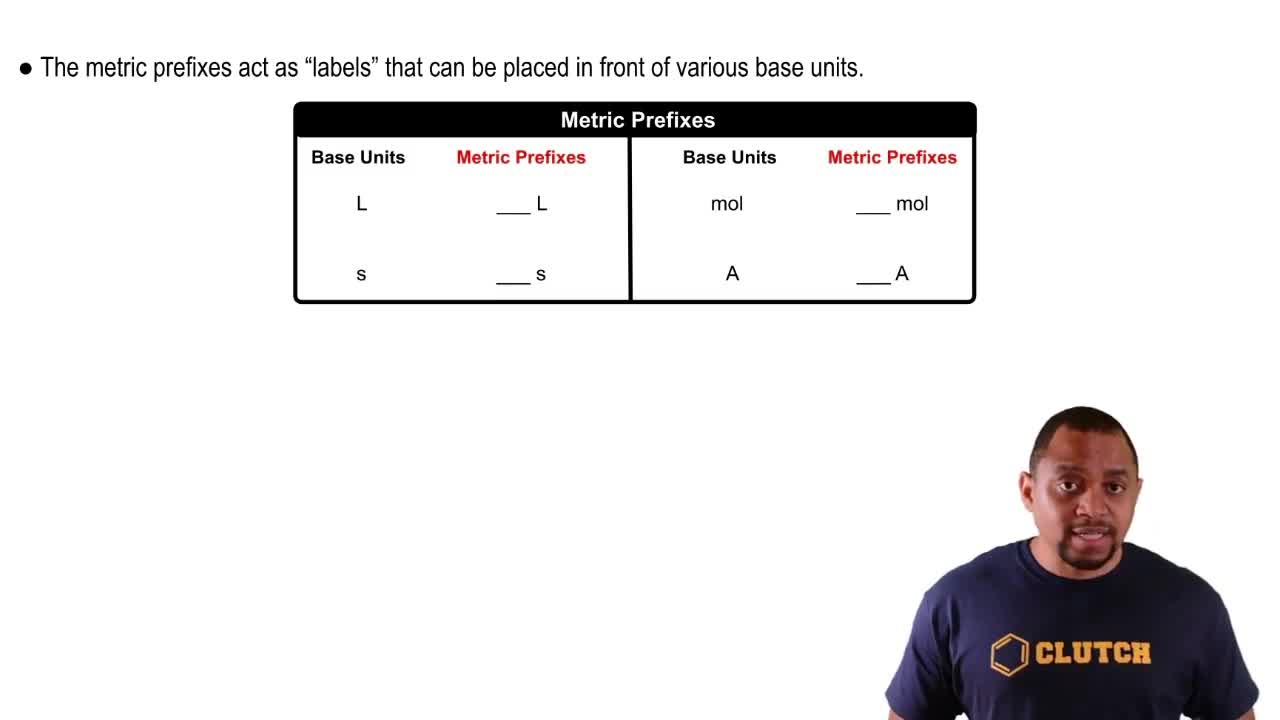
Metric Prefixes

Metric prefixes are standardized terms used to denote specific powers of ten in the metric system. They simplify the representation of large or small quantities by providing a shorthand way to express these values. For example, 'milli-' represents one-thousandth (10^-3), allowing us to convert measurements like 1.828 * 10^-3 seconds into 1.828 milliseconds.
추천 영상:
가이드 코스
01:16
Metric Prefixes Usage

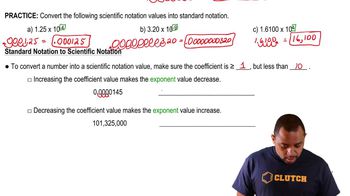
Scientific Notation

Scientific notation is a method of expressing numbers as a product of a coefficient and a power of ten, which is particularly useful for handling very large or very small numbers. In this format, a number is written as 'a × 10^n', where 'a' is a number greater than or equal to 1 and less than 10, and 'n' is an integer. Understanding how to convert from scientific notation to standard metric prefixes is essential for this question.
추천 영상:
가이드 코스
02:50
Standard Notation to Scientific Notation

Unit Conversion

Unit conversion involves changing a measurement from one unit to another while maintaining the same quantity. This process often requires knowledge of conversion factors, such as metric prefixes, to accurately translate values. In this case, converting 1.828 * 10^-3 seconds to milliseconds involves recognizing that 1 second equals 1,000 milliseconds, thus facilitating the conversion.
추천 영상:
가이드 코스
01:56
Conversion Factors