
Ch.10 - Gases
Brown - Chemistry: The Central Science 14th Edition
Brown14th EditionChemistry: The Central ScienceISBN: 9780134414232당신이 사용하는 게 아니라요?교과서 변경
10장, 문제 2b

You have a sample of gas in a container with a movable piston, such as the one in the drawing. (b) Redraw the container to show what it might look like if the external pressure on the piston is increased from 101.3 kPa to 202.7 kPa while the temperature is kept constant.

검증된 단계별 안내
1
Identify the initial conditions of the gas: the initial pressure is 101.3 kPa, and the temperature is constant.
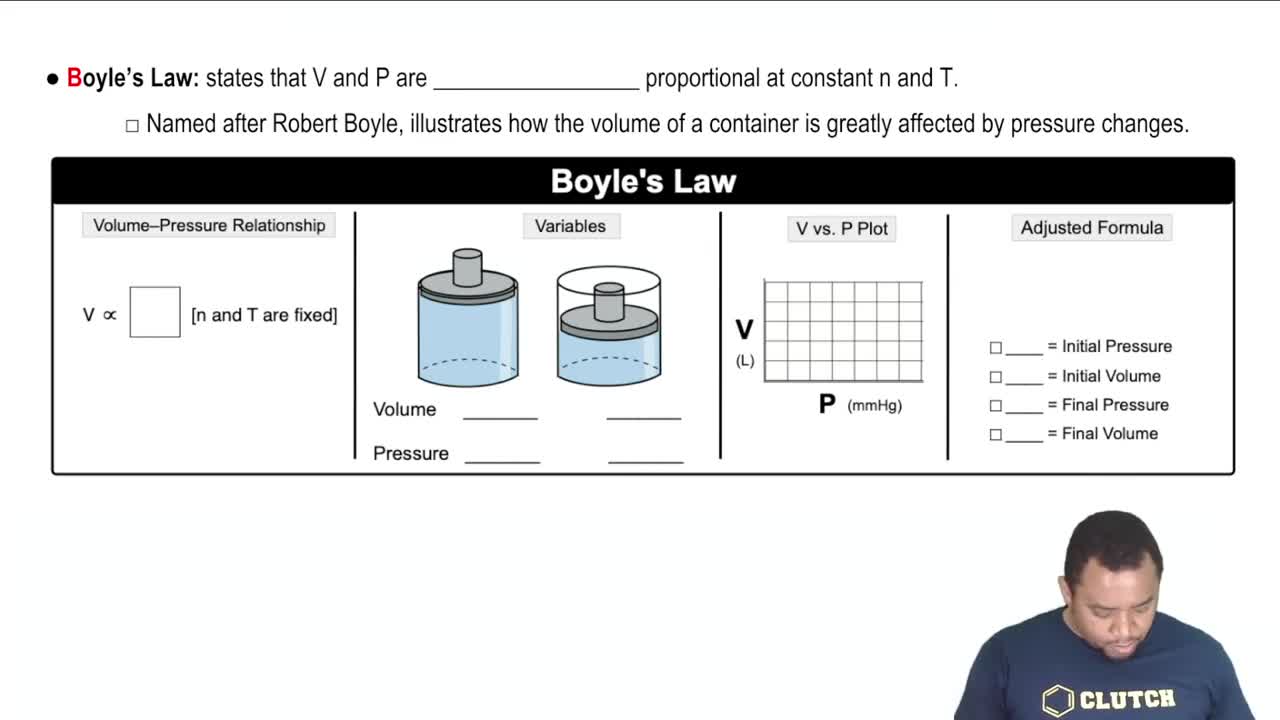
Recognize that the problem involves a change in external pressure on the gas, which affects the volume of the gas according to Boyle's Law.
Recall Boyle's Law: \( P_1V_1 = P_2V_2 \), where \( P \) is pressure and \( V \) is volume. Since the temperature is constant, this law applies.
Understand that increasing the external pressure from 101.3 kPa to 202.7 kPa will cause the volume of the gas to decrease, as pressure and volume are inversely related.
Redraw the container with the piston pushed further into the container, indicating a smaller volume of gas, while ensuring the piston is still movable and the temperature remains constant.

비슷한 문제에 대한 검증된 영상 답변:

이 영상 해법은 위 문제에 도움이 된다고 튜터들이 추천한 것입니다.
영상 길이:
1m
도움이 되었나요?

주요 개념

질문에 올바르게 답하기 위해 반드시 이해해야 하는 핵심 개념들은 다음과 같습니다.

Boyle's Law

Boyle's Law states that the pressure of a gas is inversely proportional to its volume when the temperature is held constant. This means that if the pressure on a gas increases, its volume decreases, and vice versa. This relationship is crucial for understanding how changes in external pressure affect the behavior of gases in a closed system.
추천 영상:

Gas Laws

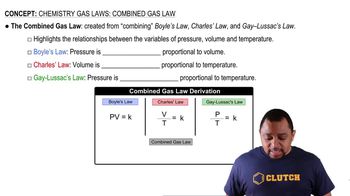
Gas laws describe the behavior of gases under various conditions of pressure, volume, and temperature. They include Boyle's Law, Charles's Law, and Avogadro's Law, among others. Understanding these laws helps predict how a gas will respond to changes in its environment, such as the effect of increased external pressure on a gas contained in a piston.
추천 영상:
가이드 코스
01:43
Combined Gas Law

Piston Mechanism

A piston mechanism is a device that allows for the compression or expansion of gases by moving a piston within a cylinder. When external pressure is applied to the piston, it compresses the gas, reducing its volume. This concept is essential for visualizing how the gas sample will change in response to the increased pressure in the given scenario.
추천 영상:
가이드 코스
03:06
Reaction Mechanism Overview