
Ch.10 - Gases
Brown - Chemistry: The Central Science 14th Edition
Brown14th EditionChemistry: The Central ScienceISBN: 9780134414232당신이 사용하는 게 아니라요?교과서 변경
10장, 문제 64

A deep-sea diver uses a gas cylinder with a volume of 10.0 L and a content of 51.2 g of O2 and 32.6 g of He. Calculate the partial pressure of each gas and the total pressure if the temperature of the gas is 19 °C.

검증된 단계별 안내
1
Step 1: Convert the temperature from Celsius to Kelvin by adding 273.15 to the Celsius temperature. This is necessary because gas law calculations require temperature in Kelvin.
Step 2: Calculate the number of moles of each gas using the formula \( n = \frac{m}{M} \), where \( n \) is the number of moles, \( m \) is the mass of the gas, and \( M \) is the molar mass of the gas. Use the molar mass of O2 (32.00 g/mol) and He (4.00 g/mol).
Step 3: Use the ideal gas law \( PV = nRT \) to calculate the partial pressure of each gas. Rearrange the formula to \( P = \frac{nRT}{V} \), where \( P \) is the pressure, \( n \) is the number of moles, \( R \) is the ideal gas constant (0.0821 L·atm/mol·K), \( T \) is the temperature in Kelvin, and \( V \) is the volume in liters.
Step 4: Calculate the partial pressure of O2 by substituting the number of moles of O2, the ideal gas constant, the temperature in Kelvin, and the volume of the cylinder into the rearranged ideal gas law equation.
Step 5: Calculate the partial pressure of He using the same method as in Step 4, substituting the number of moles of He. Then, add the partial pressures of O2 and He to find the total pressure in the gas cylinder.

주요 개념

질문에 올바르게 답하기 위해 반드시 이해해야 하는 핵심 개념들은 다음과 같습니다.

Ideal Gas Law

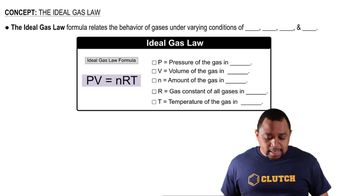
The Ideal Gas Law relates the pressure, volume, temperature, and number of moles of a gas through the equation PV = nRT. This law is essential for calculating the behavior of gases under various conditions, allowing us to determine the pressure exerted by a gas in a given volume at a specific temperature.
추천 영상:
가이드 코스
01:15
Ideal Gas Law Formula

Partial Pressure

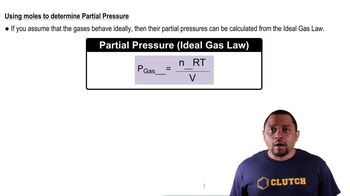
Partial pressure is the pressure that a single gas in a mixture would exert if it occupied the entire volume alone. According to Dalton's Law of Partial Pressures, the total pressure of a gas mixture is the sum of the partial pressures of each individual gas, which is crucial for solving the problem at hand.
추천 영상:
가이드 코스
00:48
Partial Pressure Calculation

Molar Mass and Moles Calculation

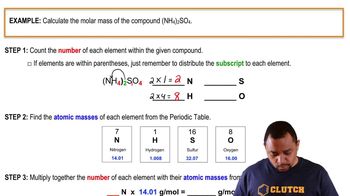
To calculate the partial pressures, it is necessary to convert the mass of each gas into moles using their respective molar masses. This conversion is vital for applying the Ideal Gas Law, as the number of moles (n) directly influences the pressure calculation for each gas in the mixture.
추천 영상:
가이드 코스
03:12
Molar Mass Calculation Example