
Ch.10 - Gases
Brown - Chemistry: The Central Science 14th Edition
Brown14th EditionChemistry: The Central ScienceISBN: 9780134414232당신이 사용하는 게 아니라요?교과서 변경
10장, 문제 122a

Ammonia and hydrogen chloride react to form solid ammonium chloride: NH31g2 + HCl1g2¡NH4Cl1s2 Two 2.00-L flasks at 25 °C are connected by a valve, as shown in the drawing. One flask contains 5.00 g of NH31g2, and the other contains 5.00 g of HCl(g). When the valve is opened, the gases react until one is completely consumed. (a) Which gas will remain in the system after the reaction is complete?

검증된 단계별 안내
1
Calculate the number of moles of NH_3 using its molar mass.
Calculate the number of moles of HCl using its molar mass.
Write the balanced chemical equation for the reaction: NH_3(g) + HCl(g) \(\rightarrow\) NH_4Cl(s).
Determine the limiting reactant by comparing the mole ratio from the balanced equation with the calculated moles of NH_3 and HCl.
Identify which gas remains by determining which reactant is in excess after the limiting reactant is completely consumed.

비슷한 문제에 대한 검증된 영상 답변:

이 영상 해법은 위 문제에 도움이 된다고 튜터들이 추천한 것입니다.
영상 길이:
4m
도움이 되었나요?

주요 개념

질문에 올바르게 답하기 위해 반드시 이해해야 하는 핵심 개념들은 다음과 같습니다.

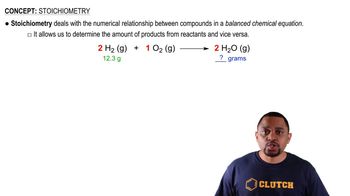
Stoichiometry

Stoichiometry is the calculation of reactants and products in chemical reactions based on the balanced chemical equation. It allows us to determine the amount of each substance involved in the reaction. In this case, knowing the molar ratios of NH3 and HCl from the balanced equation helps identify which reactant will be in excess after the reaction.
추천 영상:
가이드 코스
01:16
Stoichiometry Concept

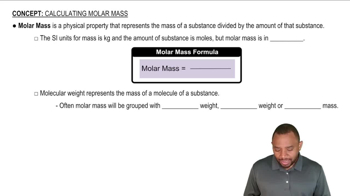
Molar Mass

Molar mass is the mass of one mole of a substance, typically expressed in grams per mole (g/mol). It is essential for converting grams of a substance to moles, which is necessary for stoichiometric calculations. For NH3 and HCl, calculating their molar masses allows us to determine how many moles of each gas are present in the flasks.
추천 영상:
가이드 코스
02:11
Molar Mass Concept

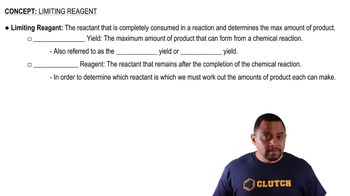
Limiting Reactant

The limiting reactant is the substance that is completely consumed first in a chemical reaction, thus determining the maximum amount of product that can be formed. Identifying the limiting reactant is crucial for predicting the outcome of the reaction. In this scenario, comparing the moles of NH3 and HCl will reveal which gas will remain after the reaction is complete.
추천 영상:
가이드 코스
01:30
Limiting Reagent Concept
관련 실천
교과서 질문

An herbicide is found to contain only C, H, N, and Cl. The complete combustion of a 100.0-mg sample of the herbicide in excess oxygen produces 83.16 mL of CO2 and 73.30 mL of H2O vapor expressed at STP. A separate analysis shows that the sample also contains 16.44 mg of Cl. (c) What other information would you need to know about this compound to calculate its true molecular formula?

679
views
교과서 질문

A 4.00-g sample of a mixture of CaO and BaO is placed in a 1.00-L vessel containing CO2 gas at a pressure of 97.33 kPa and a temperature of 25 °C. The CO2 reacts with the CaO and BaO, forming CaCO3 and BaCO3. When the reaction is complete, the pressure of the remaining CO2 is 20.0 kPa. (a) Calculate the number of moles of CO2 that have reacted. (b) Calculate the mass percentage of CaO in the mixture.

1180
views
교과서 질문

Ammonia and hydrogen chloride react to form solid ammonium chloride: NH3(g) + HCl(g) NH4Cl(s)

Two 2.00-L flasks at 25 °C are connected by a valve, as shown in the drawing. One flask contains 5.00 g of NH3(g), and the other contains 5.00 g of HCl(g). When the valve is opened, the gases react until one is completely consumed. (b) What will be the final pressure of the system after the reaction is complete? (Neglect the volume of the ammonium chloride formed.)

4501
views
교과서 질문

An herbicide is found to contain only C, H, N, and Cl. The complete combustion of a 100.0-mg sample of the herbicide in excess oxygen produces 83.16 mL of CO2 and 73.30 mL of H2O vapor expressed at STP. A separate analysis shows that the sample also contains 16.44 mg of Cl. (b) Calculate its empirical formula.

1707
views